The Complete Guide to Rucking Your First 10 Miles Without Wrecking Your Feet
Quick Answer: The path to a comfortable first 10-mile ruck is built on foot preparation, not fitness — proper footwear break-in, moisture management, and a gradual weekly mileage increase (roughly 10% per week) prevent the blisters and hot spots that end most people’s early rucking attempts long before their cardio or strength ever becomes the limiting factor.
Most rucking advice focuses on pack weight and pace. This is a full guide built around the part that actually derails beginners most often: feet.

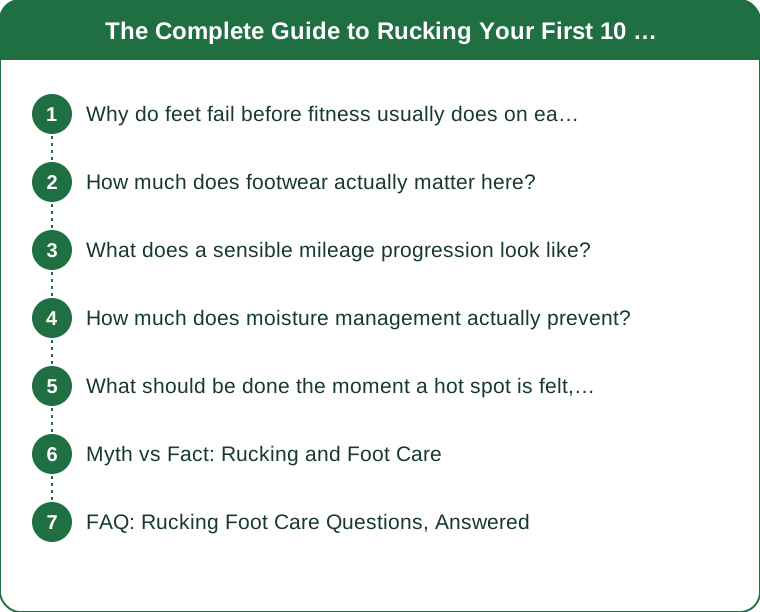
Why do feet fail before fitness usually does on early rucks?
Under load, feet experience significantly more pressure and friction per step than during regular walking or running — the extra pack weight increases both the force on each footstrike and the shear forces that cause blisters. Most beginners have a cardiovascular and muscular base that could handle 10 miles, but their feet haven’t been conditioned to the specific friction and pressure pattern that weighted walking creates, which is why foot problems end rucks well before legs or lungs do.
How much does footwear actually matter here?
Enormously — shoes broken in for regular walking or running are not automatically broken in for rucking, because the loaded gait pattern shifts pressure points slightly compared to unloaded movement. A boot or shoe that felt perfect on an unloaded 5-mile walk can create new hot spots at mile 3 of a loaded ruck. Break in any footwear with at least a few shorter loaded walks before attempting a longer distance, and pay attention to any new pressure points that only show up under weight.
What does a sensible mileage progression look like?
Jumping straight to 10 miles is where most early foot damage happens. A roughly 10% weekly mileage increase, starting from wherever your current comfortable walking distance is, gives feet time to adapt their skin and callusing to the new friction pattern gradually. Someone comfortable walking 3 miles might build to a 10-mile ruck over 6-8 weeks rather than attempting it in week one — the extra weeks feel slow but dramatically reduce blister risk along the way.

How much does moisture management actually prevent?
A significant share of rucking blisters form from friction that’s made worse by moisture — either sweat or, on longer rucks, minor rain or humidity. Moisture-wicking socks (avoiding cotton entirely), and for longer distances, a mid-ruck sock change or foot powder, meaningfully cuts blister risk by keeping the skin-sock friction interface drier. This is a small, cheap intervention relative to how much difference it makes on rucks past about 6 miles.
What should be done the moment a hot spot is felt, not after it’s already a blister?
Stopping to address a hot spot the moment it’s noticed — adjusting the sock, applying tape or a blister pad — prevents the vast majority of full blisters, whereas pushing through a hot spot for another mile almost always turns it into one. Carrying a small blister kit (moleskin or tape) on any ruck past 5 miles is worth the negligible extra pack weight, since it turns a ruck-ending problem into a 90-second fix.
Myth vs Fact: Rucking and Foot Care
Myth: thicker, more cushioned socks always mean fewer blisters. Fact: sock fit and moisture-wicking material matter more than thickness alone — a too-thick sock can create its own new pressure points inside a boot.
Myth: if your feet were fine on a 5-mile ruck, 10 miles is just double the risk. Fact: blister risk often increases non-linearly with distance, since accumulated friction and moisture compound rather than staying constant per mile.
FAQ: Rucking Foot Care Questions, Answered
How long does it typically take feet to adapt to rucking?
Most people notice meaningfully fewer hot spots after 4-6 weeks of consistent, gradually increasing rucks, as skin toughens and gait adapts to the load.
Should new boots be worn on the actual 10-mile attempt?
No — any new footwear should have at least several shorter loaded walks behind it before being tested on a longer distance ruck.
Is taping feet preventively before a long ruck worth doing?
For known trouble spots (common blister areas from past rucks), preventive taping before starting is often more effective than waiting to react to a hot spot mid-ruck.
TL;DR:
- Feet, not cardio or strength, are usually what ends a beginner’s first attempt at 10 miles
- Footwear needs to be broken in specifically under load, not just for regular unloaded walking
- A roughly 10% weekly mileage increase gives feet time to adapt to rucking’s specific friction pattern
- Moisture-wicking socks and addressing hot spots immediately prevent most blisters before they form
Getting to a comfortable first 10-mile ruck is mostly a foot-preparation project — build the mileage gradually and treat hot spots the moment they show up, and the fitness side of it tends to take care of itself.
Keep Reading
This article is for general informational and styling purposes only. Fit, sizing, and product availability may vary.