The Complete 3-Month Rucking Progression for Genuine Beginners
Quick Answer: A safe rucking progression starts with an empty or near-empty pack for the first 1-2 weeks to build walking tolerance, then adds weight gradually (roughly 10% of bodyweight by week 4, working toward 15-20% by month three), with distance and pace increasing separately from weight rather than all three variables changing at once.
Rucking looks like it should need almost no ramp-up — it’s walking with a bag. The injury data among new ruckers says otherwise, and it almost always traces back to loading too much too fast.

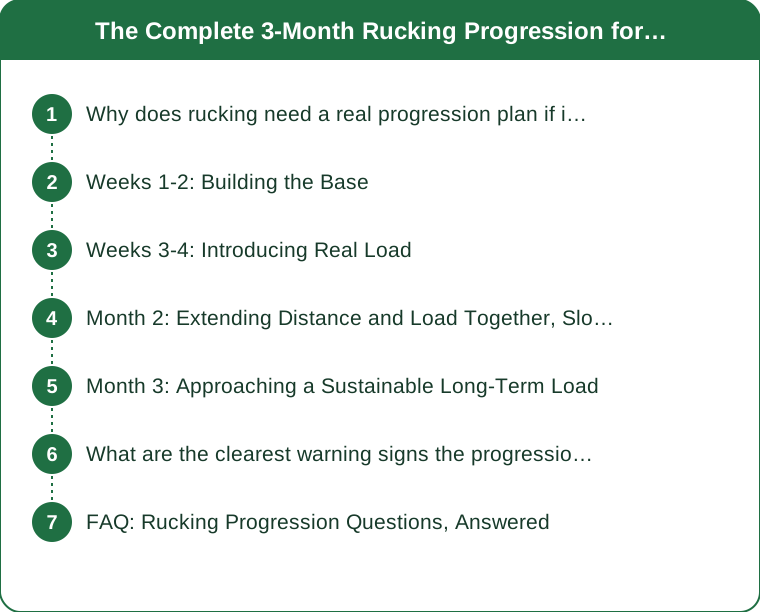
Why does rucking need a real progression plan if it’s just walking?
Added load changes the mechanical stress on joints, especially the lower back, hips, and knees, in a way that scales faster than most people expect — doubling pack weight doesn’t just double the difficulty, it meaningfully increases joint loading in a nonlinear way, especially over longer distances. Someone who can comfortably walk 5 miles unloaded can still be genuinely undertrained for a 5-mile ruck at 20% bodyweight, because the limiting factor shifts from cardiovascular fitness to joint and connective tissue tolerance, which adapts more slowly than cardio fitness does.
Weeks 1-2: Building the Base
Empty pack or very light load (5-10 lbs), 2-3 sessions per week, 20-30 minutes each. The goal here isn’t fitness — it’s establishing consistent gait mechanics and footwear comfort before adding load complicates the picture. Skipping this phase because it feels too easy is one of the most common reasons injuries show up in week 3 or 4 instead.
Weeks 3-4: Introducing Real Load
Increase to roughly 10% of bodyweight, same 2-3 sessions per week, extending to 30-40 minutes. This is where most beginners first notice load-specific fatigue in the shoulders and hips rather than general cardio fatigue — that’s expected and is the specific adaptation this phase is building toward.

Month 2: Extending Distance and Load Together, Slowly
Progress toward 12-15% of bodyweight, sessions extending to 45-60 minutes, one session per week pushing distance further than the others. Weight and distance should not both increase aggressively in the same week — a rough rule is to increase one variable by no more than 10% per week, alternating which variable increases when both need to grow.
Month 3: Approaching a Sustainable Long-Term Load
15-20% of bodyweight becomes a reasonable target range for most people by month three, with session length varying between 45-90 minutes depending on goals. Going beyond 20-25% of bodyweight is where injury risk climbs meaningfully faster than fitness benefit for most recreational ruckers, which is worth treating as a soft ceiling rather than a target to exceed.
What are the clearest warning signs the progression is moving too fast?
Sharp joint pain (as opposed to general muscle fatigue), noticeable pain that persists more than 48 hours after a session, or form breakdown (leaning forward excessively, uneven gait) partway through a ruck are all signals to hold at the current load rather than progress further that week. Rucking injuries tend to build gradually rather than happen suddenly, which makes catching early warning signs more valuable than reacting after pain is already significant.
FAQ: Rucking Progression Questions, Answered
Is it necessary to use a dedicated rucking pack, or does a regular backpack work?
A dedicated rucking pack with a load close to your back (not hanging low) reduces strain significantly compared to a standard backpack, especially once weight climbs past the beginner range — it’s a worthwhile investment once you’re progressing past the first month.
Should rucking be combined with other training, or done on its own?
Most people combine it with strength training and other cardio rather than as a standalone practice — treating heavy ruck days similarly to a leg day in terms of recovery time before the next hard session is a reasonable approach.
Is footwear different for rucking compared to regular walking or running shoes?
Supportive, well-broken-in footwear with good ankle stability matters more for rucking than for unloaded walking, since added weight increases the consequences of an ankle roll or blister meaningfully.
TL;DR:
- Rucking’s mechanical load scales faster than difficulty seems to suggest — a real progression matters
- Weeks 1-2 build gait and footwear tolerance before any real weight is added
- Weight and distance should increase separately, roughly 10% per week, not both at once
- 15-20% of bodyweight is a reasonable 3-month target; sharp or persistent pain means holding steady, not pushing through
The simplicity of rucking is real — the progression it needs to stay safe is just as real, and skipping it is where most beginner injuries actually come from.
Keep Reading
This article is for general informational and styling purposes only. Fit, sizing, and product availability may vary.