Why Your Shoulders Hurt More Than Your Legs When Rucking (And How to Fix It)
Quick Answer: Shoulder pain while rucking usually means your pack’s hip belt isn’t carrying its share of the load — a properly tightened hip belt should carry 70-80% of the weight, taking pressure off your shoulders entirely.
Your legs feel strong and ready for more distance, but your shoulders are screaming by mile two. That imbalance is a loading problem, not a fitness problem.

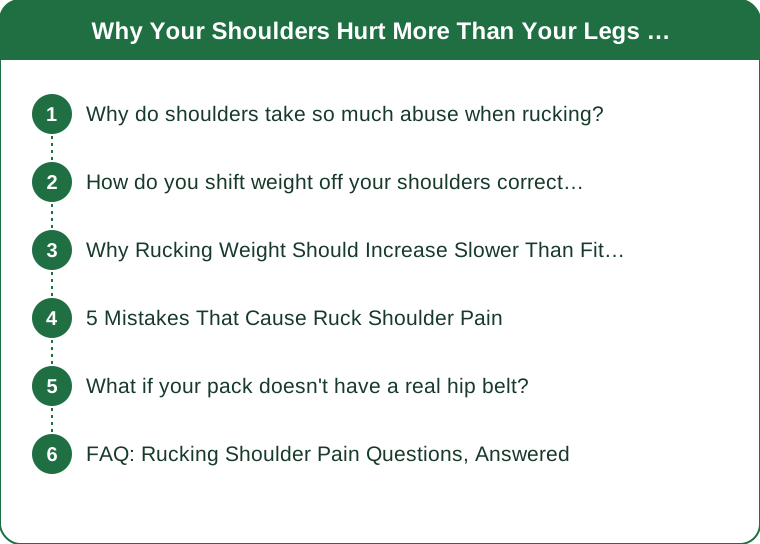
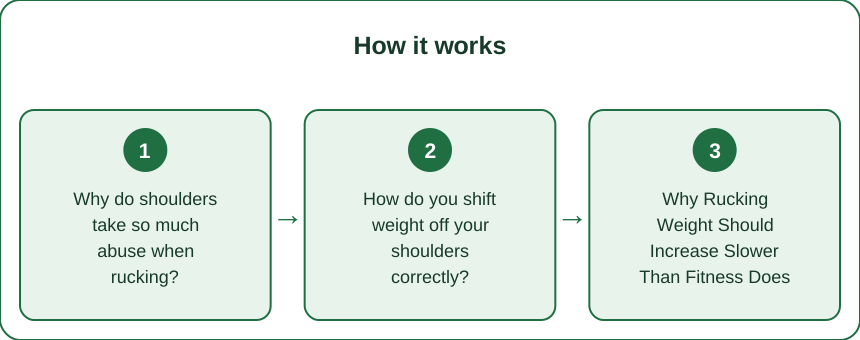
Why do shoulders take so much abuse when rucking?
Rucking is meant to be a hip-and-core-carried activity, similar to a well-fitted hiking backpack, with the shoulder straps mainly there for stability rather than primary weight-bearing. When the hip belt is loose or the pack rides too high, the shoulder straps end up carrying weight they were never designed to support long-term.
This is an extremely common mistake, especially with rucking-specific packs that have simpler harness systems than dedicated hiking packs and can make it less obvious that the hip belt matters this much.
How do you shift weight off your shoulders correctly?
Tighten the hip belt first, snug around the top of your hip bones, before adjusting the shoulder straps at all. Once the hip belt is secure and bearing weight, tighten shoulder straps just enough to stabilize the pack against your back — they shouldn’t be pulling weight upward.
A quick check: with everything adjusted, try shrugging your shoulders. If the pack noticeably shifts or feels lighter when you shrug, your shoulders are carrying too much and the hip belt needs to come in tighter.
Why Rucking Weight Should Increase Slower Than Fitness Does
It’s tempting to add weight as your cardio improves, but your shoulders, hip flexors, and connective tissue adapt more slowly than your cardiovascular fitness does. Many people feel ready for more weight after a few weeks because their breathing and legs feel strong, then get shoulder or lower back pain because the structural tissue hasn’t caught up yet.
A safer progression is adding weight every 3-4 weeks in small 5-pound increments, rather than following how good your cardio feels week to week.

5 Mistakes That Cause Ruck Shoulder Pain
- Loose or unused hip belt, letting shoulders carry the full load
- Pack riding too low, pulling shoulders backward and down
- Adding weight too fast relative to connective tissue adaptation
- Ignoring posture — hunching forward under load instead of staying upright
- Using a non-rucking backpack without a structured frame or padded hip belt
What if your pack doesn’t have a real hip belt?
A basic daypack repurposed for rucking often lacks a structured hip belt capable of actually bearing weight, which forces everything onto the shoulders no matter how you adjust the straps. If you’re serious about rucking regularly, investing in a pack with a padded, structured hip belt is one of the highest-value gear upgrades you can make — it changes the entire load experience.
In the meantime, reducing pack weight and shortening ruck distance is a safer stopgap than pushing through shoulder pain with inadequate gear.
FAQ: Rucking Shoulder Pain Questions, Answered
How tight should a rucking hip belt be?
Snug enough that it doesn’t shift when you walk or shrug, sitting on top of your hip bones, not around your waist.
Is shoulder pain from rucking a sign I’m using too much weight?
Not necessarily weight amount — it’s often a loading distribution issue first; fix the hip belt fit before reducing weight.
How fast should I increase ruck weight?
Small increments (around 5 pounds) every 3-4 weeks is a reasonable pace that respects how slowly connective tissue adapts compared to cardio fitness.
TL;DR:
- Shoulder pain usually means the hip belt isn’t carrying its share of the load
- Tighten the hip belt first, snug on the hip bones, before shoulder straps
- Increase weight slowly — connective tissue adapts slower than cardio
- A pack without a real hip belt forces everything onto your shoulders
This is general information, not medical advice — see a professional if shoulder pain persists or radiates beyond normal muscle fatigue.
Keep Reading
This article is for general informational and styling purposes only. Fit, sizing, and product availability may vary.