How Heavy Should Your Ruck Actually Be? A Simple Formula That Beats Guessing
Quick Answer: Beginners should start around 10% of bodyweight (roughly 10-20lbs for most people), building toward 15-20% over 8-12 weeks as conditioning improves — going heavier faster is the single most common rucking mistake.
Military rucking culture normalized loading up heavy from day one, and that advice leaked into civilian fitness without the months of prior conditioning that made it safe for those populations. Here’s a formula that actually fits a realistic starting point.

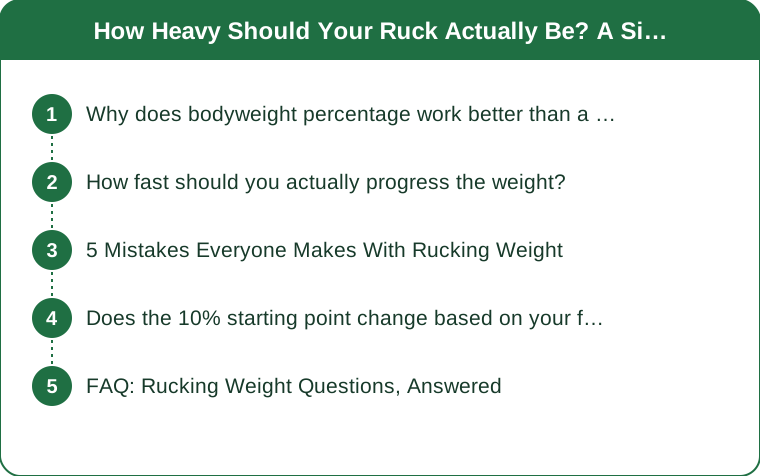
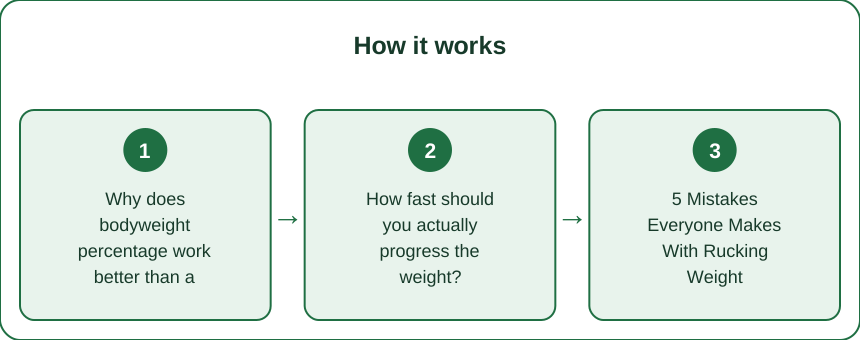
Why does bodyweight percentage work better than a flat weight recommendation?
Because load tolerance scales with body size and existing strength, not a fixed number. A flat “start with 30lbs” recommendation might be trivial for one person and genuinely risky for another — 10% of bodyweight normalizes the starting point across different body sizes and current fitness levels.
For a 150lb person, that’s 15lbs; for a 200lb person, 20lbs. Both are proportionally similar stress on the body, which a flat number can’t guarantee.
How fast should you actually progress the weight?
Slower than feels necessary. A reasonable progression adds roughly 5% of bodyweight every 2-3 weeks, assuming no joint pain or excessive fatigue — reaching the commonly cited 15-20% “working load” range over 8-12 weeks rather than jumping there in week two.
Rucking loads your spine and joints under repeated impact over distance — this is a case where patience genuinely reduces injury risk, not just theoretically.

5 Mistakes Everyone Makes With Rucking Weight
1. Copying military-standard loads immediately. Those standards assume months of prior conditioning most beginners don’t have.
2. Loading weight incorrectly in the pack. Weight sitting too low creates a pendulum effect that strains the lower back — pack weight should sit high and close to your spine.
3. Increasing weight and distance at the same time. Progress one variable at a time — add weight on a stable distance, or add distance at a stable weight, not both simultaneously.
4. Using a non-rucking backpack. Standard backpacks lack the frame and hip-belt support designed to distribute rucking loads properly, concentrating strain on the shoulders instead.
5. Ignoring footwear. Extra load changes your gait and impact forces — worn-out shoes designed for unloaded walking don’t hold up the same way loaded.
Does the 10% starting point change based on your fitness background?
Somewhat. Experienced lifters or hikers with strong baseline conditioning can often reasonably start closer to 12-15%, while complete beginners to loaded carrying should stay conservative at 10% or even less for the first few sessions.
The more reliable adjustment factor: if your first loaded walk leaves you with joint discomfort (not just muscle fatigue) the next day, that’s a signal to drop back down rather than push the formula.
FAQ: Rucking Weight Questions, Answered
What’s a good maximum weight to work toward for regular rucking?
Most recreational rucking guidance tops out around 20-25% of bodyweight for regular training use — beyond that starts entering specialized or event-specific territory, not general fitness.
Should women ruck with less weight than men?
The bodyweight-percentage approach already accounts for this — using % of bodyweight rather than a flat number naturally scales appropriately across different body sizes and strength levels.
How do I know if my ruck weight is too heavy?
Joint pain (versus normal muscle fatigue), significantly altered walking gait, or excessive next-day soreness all signal the load is ahead of your current conditioning — scale back and progress more gradually.
TL;DR:
- Start around 10% of bodyweight, not a flat number everyone copies
- Progress roughly 5% of bodyweight every 2-3 weeks toward a 15-20% working load
- Change one variable at a time — weight or distance, not both together
- Joint discomfort (not muscle fatigue) is the signal to scale back the formula
A slower, bodyweight-scaled build beats guessing a number off someone else’s routine.
Keep Reading
This article is for general informational and styling purposes only. Fit, sizing, and product availability may vary.