Why Rucking Progress Should Come From Pace Before Weight, Not the Other Way Around
Quick Answer: For most people, increasing walking pace at a stable, moderate ruck weight builds cardiovascular fitness and movement efficiency faster than adding weight, and it puts far less cumulative stress on the joints, back, and feet — weight increases are generally better saved until pace and form are both solid.
A heavier pack might feel like faster progress, but it’s often just faster wear and tear if pace and form haven’t caught up yet.

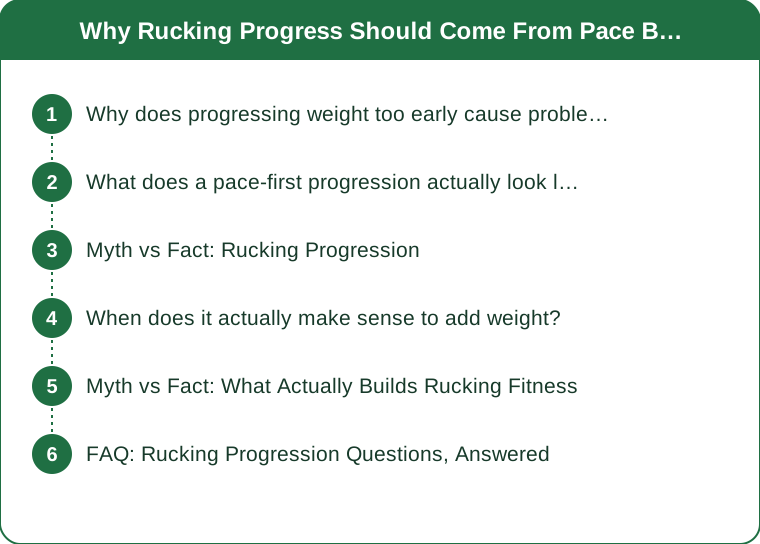
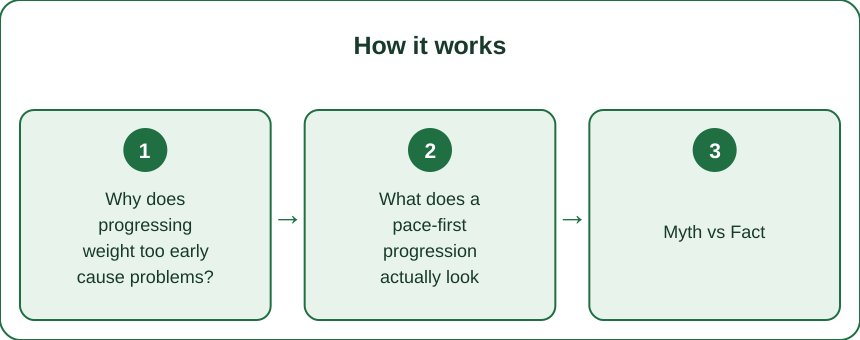
Why does progressing weight too early cause problems?
Adding weight before pace and posture are dialed in tends to amplify existing form issues rather than build new capacity — a slight forward lean or uneven stride becomes a bigger structural stress under a heavier load. Joint and connective tissue adaptation also happens slower than cardiovascular adaptation, meaning weight increases that outpace that slower timeline are a common source of overuse injury in rucking specifically.
This is part of why rucking communities generally recommend a much slower weight progression curve than people expect coming from general strength training, where adding load quickly is often the norm.
What does a pace-first progression actually look like in practice?
A pace-first approach holds ruck weight steady, often somewhere around 10 to 20 percent of bodyweight for a few weeks at a time, while gradually increasing walking speed or distance covered in the same time window. Once a given weight feels genuinely comfortable at a faster pace over a full session, that’s a more reliable signal for a weight increase than simply following a preset schedule.
Tracking pace over several weeks — the same route or distance getting noticeably faster at the same weight — gives a much clearer fitness signal than tracking weight added alone, since weight alone doesn’t account for how much harder or easier a session actually felt.
Myth vs Fact: Rucking Progression
Myth: heavier weight is always the marker of real rucking progress. Fact: pace, distance, and how a given weight feels are all more meaningful progress markers than weight alone, especially early on.
Myth: increasing weight and pace together speeds up progress. Fact: increasing both variables simultaneously removes any clear signal for which change caused new soreness or strain, making it harder to progress safely.

When does it actually make sense to add weight?
Weight increases make the most sense once a current load feels clearly manageable across a full planned distance, with stable posture and no lingering soreness beyond normal training fatigue. Small, incremental increases — roughly 5 to 10 percent of current load — tend to be safer than large jumps, even for people who feel ready for more.
Some rucking programs suggest holding a new weight steady for two to three full weeks before considering another increase, giving connective tissue enough time to adapt rather than chasing continuous weekly increases.
Myth vs Fact: What Actually Builds Rucking Fitness
Myth: rucking fitness is primarily a strength adaptation. Fact: rucking fitness draws heavily on cardiovascular conditioning and movement efficiency, not just raw load-bearing strength, which is why pace matters as much as weight.
Myth: a punishing first few sessions means the training is working. Fact: excessive early soreness or joint discomfort is more often a sign of progressing too fast than a sign of an especially effective program.
FAQ: Rucking Progression Questions, Answered
How often should ruck weight actually increase for a beginner?
Roughly every 2 to 4 weeks is a reasonable pace for most beginners, prioritizing comfort and form over a fixed increase schedule.
Is it fine to increase pace and distance at the same time?
Generally yes, since both track overall conditioning, but it’s still worth increasing one more than the other in any given week to gauge what’s actually driving improvement.
Does terrain count as an equivalent progression to adding weight?
To some extent — hillier or uneven terrain adds real difficulty without adding pack weight, making it a reasonable alternative progression variable.
TL;DR:
- Pace-first progression builds fitness with less joint and connective tissue stress than weight-first progression
- Hold weight steady while pace or distance increases, then reassess
- Add weight in small increments once a load feels clearly manageable
- Rucking fitness leans heavily on cardiovascular conditioning, not just load strength
Let pace tell you when you’re ready for more weight — not the other way around.
Keep Reading
This article is for general informational and styling purposes only. Fit, sizing, and product availability may vary.