Rucking vs Running: The Honest Comparison for Cardio, Joints and Real Life
Rucking gets sold as running’s replacement and running as rucking’s superior — while the honest comparison shows two different tools: one buys intensity with impact, the other buys load with time. The head-to-head: the physiology, the decision guide and the both-and week.

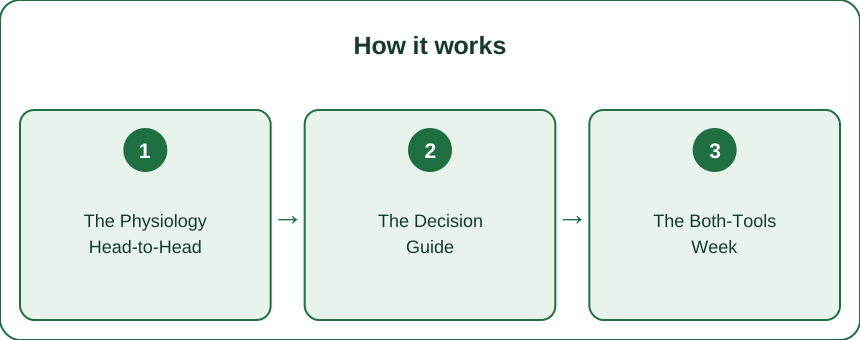
The Physiology Head-to-Head
What each actually delivers: the cardio comparison (the running reaching higher intensities faster — the VO2max work from the interval doctrine being running’s home turf; the rucking living in zone-2 — the conversational engine-building at walking pace per the base doctrine), the calorie math (the rucking burning meaningfully more than walking and less than running per minute — the 30-40 percent premium over unloaded walking; the time trade: the hour ruck matching the half-hour easy run), the impact ledger (the running’s landing forces versus the rucking’s grounded stride — the joint-friendly loading from the low-impact doctrine; the rucking being cardio for the impact-averse), the strength difference (the rucking’s load building posture, traps and legs — the strength-flavored cardio that running can’t offer per the carry doctrine; the bone loading both deliver differently), and the injury profiles (the running’s overuse tier from the runner doctrine versus the rucking’s gentler-but-real pack-fit and progression risks — the both-need-gradualism truth).
The Decision Guide
Tool by goal and body: the fat-loss seeker (the both-work verdict — the rucking’s volume tolerance advantage: the daily rucks that daily runs would injure; the NEAT-friendly tool per the metabolism doctrine), the cardio-ceiling chaser (the running or the erg from the rowing doctrine — the high-intensity work rucking can’t reach without becoming a slog), the joint-story reader (the knee-and-impact histories leaning ruck — the stairs-pain and comeback populations from the respective doctrines; the running return often routed THROUGH rucking), the time-budget reality (the running’s efficiency for the minute-poor — the lunch-run versus the commute-ruck; the rucking’s errand-integration advantage: the loaded grocery walk counting per the NEAT doctrine), the temperament match (the runner’s-high seekers versus the podcast-walkers — the sustainable choice per the adherence doctrine), the age-and-strength angle (the masters tier’s rucking lean — the muscle-and-bone stimulus with recoverable intensity per the masters doctrine), and the no-loser verdict (the both being excellent — the choice being fit, not hierarchy).

The Both-Tools Week
Using them together: the complementary design (the run days for intensity, the ruck days for volume — the polarized structure from the training doctrine with tools assigned; the hard-easy rhythm built in), the sample week (the two runs — one interval, one easy; the two-three rucks — the commute or evening loops; the strength sessions from the muscle doctrine beside both), the runner’s-rucking uses (the recovery-day rucks that replace junk miles — the aerobic base built without impact budget; the injury-season substitution per the comeback doctrine), the rucker’s-running uses (the weekly run maintaining the speed gear — the fast-twitch defense per the plyo doctrine; the run-ruck brick for the ambitious), the progression coordination (the combined load counted honestly — the tissue budget from the load doctrine; the new tool added gradually while the old one holds), and the event options (the ruck events and trail races that blend both — the GORUCK-style challenges and the hike-run formats; the goal that uses the whole toolkit per the goal doctrine).
The Practical Close
Choosing your mix: the start-question (the ‘which will I actually do Tuesday’ test — the adherence law deciding per the consistency doctrine), the entry economics (the rucking’s start-today cost from the gear doctrine versus the running’s shoe investment — the both being cheap), the social layers (the run clubs versus the ruck clubs from the community doctrines — the both offering the group multiplier), the seasonal flexing (the summer dawn runs and the winter rucks — the tools rotated by weather per the seasonal doctrine), the identity permission (the rucker being a complete athlete and the runner needing no pack — the both-and being optional, not mandatory; the one-tool life fully legitimate per the minimal doctrine), and the closing verdict (the running buying intensity with impact, the rucking buying strength with time — the tools priced honestly; the week designed from goals; the door exited, either way, which was the entire point). Run for the ceiling, ruck for the volume, walk out the door regardless: the comparison, settled by your Tuesday.
Running buys intensity with impact; rucking buys strength-flavored volume with time — a 30-40% burn premium over walking, joint-gentle, but it can’t reach running’s cardio ceiling. Sore knees lean ruck, time-poor lean run, and the best week uses both: runs for intensity, rucks for recovery volume.
Keep Reading
This article is for general informational and styling purposes only. Fit, sizing, and product availability may vary.