The Complete Guide to Fitting a Ruck Pack to a Shorter Torso
Quick Answer: Ruck packs are sized by torso length — the distance from the bony bump at the base of your neck to the top of your hip bones — not by height. If the frame is longer than your torso, the hip belt rides above your hips, the load transfers to your shoulders instead of your pelvis, and you get shoulder and neck pain regardless of how light the pack is. Measure your torso, buy a short or extra-short frame if you are under about 43cm, and set the hip belt first, straps second. Fit fixes more rucking pain than weight reduction does.
Everything you read says shoulder pain means your ruck is too heavy.
You drop the weight and the shoulders still hurt.
The weight was never the problem.

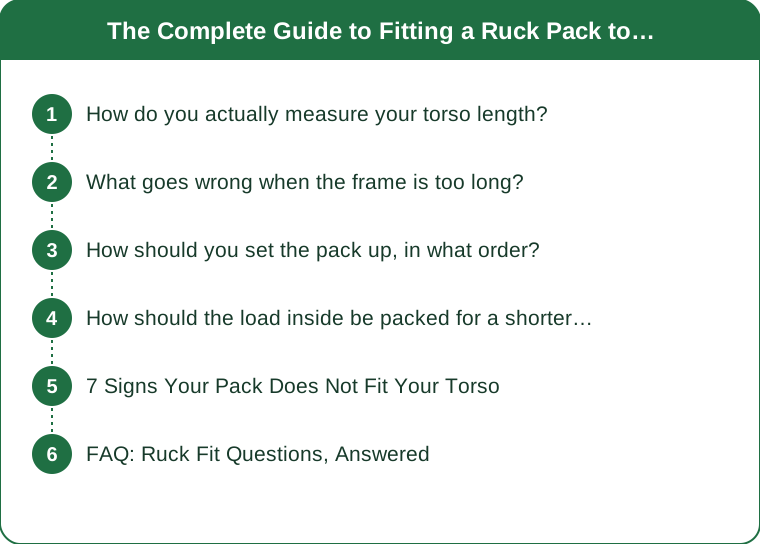
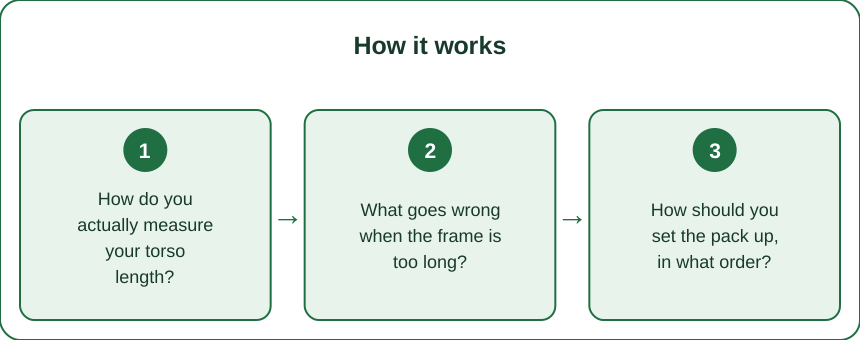
How do you actually measure your torso length?
It takes two minutes and it is the single most useful number in rucking.
Find the C7 vertebra. Tip your head forward. The bone that protrudes most at the base of your neck is the top of the measurement.
Find the iliac crest. Put your hands on your hips with thumbs pointing back. The imaginary line between your thumbs, level with the top of your hip bones, is the bottom of the measurement.
Measure along the curve of your spine, not in a straight line through the air. You will need someone else, or a mirror and a soft tape.
The typical brackets: extra-short around inches 13 to 15 (33 to 38cm), short around 15 to 17in (38 to 43cm), regular around 17 to 20in (43 to 51cm), long above that.
Height tells you almost nothing. Two people of the same height can differ by several centimetres in torso length, because leg length varies far more than people assume. This is precisely why so many women end up in packs that do not fit — they buy by height or by ‘women’s’ labelling rather than by the measurement.
Write it down. It does not change, and it makes every future pack purchase a two-minute decision instead of a gamble.
A note on ‘women’s specific’ packs: these usually mean a shorter frame, narrower shoulder strap spacing, and a hip belt shaped for a wider iliac crest angle. All three matter, but the frame length matters most, and some unisex packs in a short size fit better than a poorly designed women’s model.
What goes wrong when the frame is too long?
A predictable chain, and every link of it gets blamed on something else.
The hip belt sits above the iliac crest. It ends up around your waist, where there is no bone structure to carry weight. Instead of transferring load to your skeleton, it squeezes soft tissue — which is why an overtightened belt in the wrong position causes stomach discomfort and does nothing for your shoulders.
Load transfers to the shoulders by default. A properly fitted ruck puts roughly 70 to 80 percent of the weight through the hips. A badly fitted one puts most of it through two straps across your trapezius, which is exactly where people report pain.
Load lifter straps stop working. These are the small straps running from the top of the shoulder straps back to the frame. They should form roughly a 45-degree angle. If the frame is too tall, that angle collapses and the pack pulls backward, away from your back.
The pack’s centre of gravity sits too high. You compensate by leaning forward, which loads the lower back and changes your gait over distance.
Shoulder straps sit too wide. A frame built for a broader back spaces the straps outside the natural line of the shoulders, so they slide outward and rub near the armpit.
And the top of the pack hits your head. Annoying on flat ground, genuinely limiting on hills where you need to look up.
How should you set the pack up, in what order?
Order matters more than any individual adjustment. Most people do this backwards.
Load the pack first, to roughly the weight you will carry. Fitting an empty pack tells you nothing — the frame behaves differently under load.
Loosen everything. Shoulder straps, load lifters, sternum strap, hip belt. Start from neutral.
Hip belt first, and this is the whole game. Position the padded centre of the belt over the top of your iliac crest, not around your waist and not below the bone. Tighten firmly. You should be able to shrug the shoulder straps loose and have the pack stay put.
Shoulder straps second, and only snug. They stabilise; they do not carry. If tightening them lifts the pack off your hips, the belt is in the wrong place.
Load lifters third, to about 45 degrees. Pull gently until the gap between the top of the shoulder strap and the pack closes. Over-tightening these pulls the pack into your neck.
Sternum strap last, and loosely. Its only job is stopping the shoulder straps sliding outward. It should sit a couple of centimetres below your collarbones, and it should never be tight enough to restrict breathing — a common and genuinely uncomfortable mistake on women’s builds.
Recheck at ten minutes. Everything settles under load. A ruck that felt right at the car often needs a hip belt re-cinch a kilometre in.

How should the load inside be packed for a shorter torso?
Weight placement matters more, not less, when the frame is short.
Heavy items go high and close to your spine. For rucking on roads and paths, the dense weight — plates, water, books — sits between your shoulder blades and against your back panel, not at the bottom of the pack.
Lower is only better on technical ground. A lower centre of gravity improves balance on uneven terrain but increases the leverage pulling the pack away from you. For most rucking, high and close wins.
Away from the back panel is the mistake. Every centimetre the weight sits away from your spine multiplies the backward pull on your shoulders. This is the reason a 10kg pack packed badly feels worse than a 14kg pack packed well.
Fill the gaps. A load that shifts as you walk changes the pack’s balance with every step and produces fatigue that has nothing to do with the weight itself. Soft items around the dense ones, and cinch straps pulled in.
Use a plate or a fitted weight rather than loose items. A dedicated ruck plate sitting flat against the back panel is far more comfortable than the same mass in dumbbells or tins, which is what most people start with.
Watch the total, honestly. For a beginner, 10 percent of bodyweight is a sensible starting load, building slowly toward 15 to 20 percent over months. Shorter frames do not carry less weight inherently — but a badly fitted short frame reaches its limit much sooner, and people mistake that for a strength ceiling.
7 Signs Your Pack Does Not Fit Your Torso
The hip belt sits at your natural waist. It should be lower, over the hip bones. This is the giveaway.
Shoulder straps carry most of the weight even when the belt is tight. Correct fit means you can loosen the shoulders and the pack barely moves.
Load lifter straps are flat or angle downward. They should rise at roughly 45 degrees from the strap to the frame.
The top of the pack contacts the back of your head on inclines. The frame is taller than your torso, full stop.
Shoulder straps slide outward toward your arms. Strap spacing is too wide, and the sternum strap is compensating for a fit problem it cannot fix.
You get numbness or tingling in your hands. Straps are compressing the area near the collarbone. Stop and refit; do not push through this one.
A gap between the lumbar pad and your lower back. The frame’s curve does not match your spine, so nothing sits where it should.
And the honest one: if you have reduced weight twice and the shoulders still hurt, the pack is the problem. No load is light enough to make a badly fitted frame comfortable.
This is general information, not medical advice. Persistent numbness, tingling or nerve-type pain warrants assessment rather than another adjustment.
FAQ: Ruck Fit Questions, Answered
Can I make a too-long frame work?
Some packs have adjustable suspension that shortens the effective torso length. If yours does, use it. If not, no amount of strap adjustment compensates for the wrong frame size.
How tight should the hip belt be?
Firm enough that the pack does not sag when you loosen the shoulder straps, loose enough to breathe normally. You will re-tighten it as the load settles.
Where exactly should the sternum strap sit?
Around two to three centimetres below the collarbones. Higher restricts breathing, lower does not stop the straps sliding.
Do I need a women’s specific pack?
Not necessarily. You need the right torso length and appropriate strap spacing. A unisex short frame often fits better than a poorly designed women’s model.
Why does my pack feel fine at the start and terrible at 5km?
The load settles, the belt loosens, and fatigue changes your posture. Re-cinch the hip belt at ten minutes and again at halfway.
Should the weight sit high or low?
High and close to the spine for roads and paths; lower for technical, uneven ground where balance matters more.
How much should a beginner carry?
Around 10 percent of bodyweight, increasing gradually. Fit first, weight second — always in that order.
TL;DR:
- Packs are sized by torso length, not height. Measure C7 to iliac crest and write the number down.
- Under about 43cm means a short or extra-short frame, regardless of how tall you are.
- Fit in order: hip belt over the hip bones first, shoulder straps snug second, load lifters at 45 degrees, sternum strap last and loose.
- Pack heavy weight high and against your spine for road rucking.
- If shoulder pain persists after two weight reductions, it is a fit problem, not a load problem.
Measure your torso this week. It is the number that decides whether every future ruck is comfortable or not.
Keep Reading
This article is for general informational and styling purposes only. Fit, sizing, and product availability may vary.