The Complete Guide to Rucking in Wet Weather and What Actually Changes
Quick Answer: Wet weather rucking is a genuinely different activity, not the same activity in worse conditions. Your pack gets heavier as it absorbs water, wet skin blisters at roughly a fraction of the friction dry skin tolerates, footing changes your gait and your effort, and heat loss accelerates the moment you stop moving. The adjustments that matter most are waterproofing the load rather than yourself, changing socks before you think you need to, and cutting the planned distance rather than the pace.
This guide covers the physics, the gear, the skin, and how to plan a wet ruck that does not end badly.

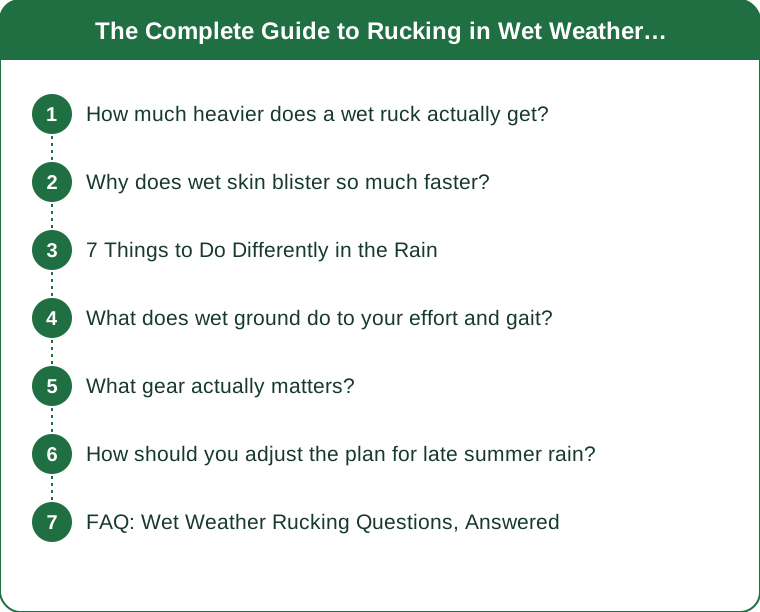
How much heavier does a wet ruck actually get?
More than people expect, and the weight arrives gradually so you attribute the effort to fatigue.
A standard nylon or canvas pack absorbs water. So does everything soft inside it that is not sealed — spare clothing, a towel, a fabric organizer. So does the pack’s padding, its straps, and the shirt on your back.
The numbers vary with material and rainfall, and the general shape is consistent: a soaked pack and soaked clothing can add several pounds to what you set out with. For someone rucking a modest weight, that can be a noticeable percentage increase over the course of a couple of hours.
Crucially, the added weight is not distributed the way your load is. Water pools in the bottom of a pack. Absorbed water sits in the fabric and padding, which is mostly at the back panel and shoulder straps. The center of mass shifts down and slightly back, which changes how the pack rides and increases the tendency to pull you backward on climbs.
The practical consequence: a ruck that felt well-balanced at the start feels bottom-heavy by hour two, and the correction people make instinctively — leaning forward more — adds load to the lower back.
There is a second, less obvious weight effect. Wet boots and wet socks add weight at the far end of a long lever, and weight on the feet costs disproportionately more energy than the same weight on your back. Estimates for carried weight on the feet versus the torso run several times higher in energy cost per unit. Soaked footwear is a bigger tax than a soaked pack.
Why does wet skin blister so much faster?
Because moisture changes the mechanical properties of skin, and it happens quickly.
Dry skin under repeated rubbing tolerates a certain amount of shear before the layers separate and a blister forms. Wet skin is softer, weaker in shear, and has a higher coefficient of friction against fabric. The result is that the same walk that produces nothing dry can produce blisters in an hour when wet.
This is why the classic advice about breaking in boots misses the point in rain. A perfectly broken-in boot and a well-fitted sock will still blister on wet feet, because the variable that changed was the skin, not the fit.
The process is also self-accelerating. Once skin is soft, it deforms more under each step, which increases the shear, which softens and damages it further. The window between everything feels fine and this is a problem is short, and it typically closes without warning.
There is a related issue people forget: friction points elsewhere. Wet fabric against wet skin at the hip belt, the shoulder straps, and the underarm chafes far more aggressively than dry. For anyone rucking a meaningful distance, the hip belt line is the most common wet-weather chafe location, and it is one that does not announce itself until it is raw.
And cold makes it worse in an indirect way. Cold, wet hands and reduced sensation mean you notice a developing hot spot later than you would in dry conditions. The signal that would normally prompt you to stop and fix something arrives late.
7 Things to Do Differently in the Rain
Waterproof the load, not yourself. A pack liner — a heavy-duty bin bag works — keeps the contents dry and keeps absorbed weight down. A pack cover helps with the outside. Accepting that you will get wet and keeping the contents dry is a better strategy than trying to stay dry, which fails anyway once you sweat under a shell.
Change socks before you think you need to. Carry a dry pair in a sealed bag and swap at the midpoint, not at the point of discomfort. Once a hot spot has formed, the sock change is damage control rather than prevention.
Cut distance, not pace. Effort per mile goes up in wet conditions, and the failure modes — blisters, chafe, cold — are all functions of time on feet. A shorter route at your normal pace is safer than the full route slowed down.
Tape or lube known friction points before you start. The hip belt line, the heels, and anywhere you have chafed before. Prevention costs two minutes; treatment costs the rest of the ruck.
Reduce the weight. This is the one people resist. If you normally carry a certain load, taking a portion off for a wet session accounts for the water you will absorb and the higher energy cost of wet footing. You will still end up near your usual working load.
Add a genuinely warm layer, sealed and unused. Not the shell you are wearing. A dry insulating layer in a waterproof bag that only comes out if you stop. Heat loss when you stop moving in wet clothing is fast, and the layer you have been sweating in provides almost nothing.
Shorten your stride on descents and wet surfaces. Wet leaves, wet rock, and wet painted lines are all considerably more slippery than they look, and a loaded pack makes a slip much harder to recover from. Descents with weight are where wet-weather rucking injuries actually happen.

What does wet ground do to your effort and gait?
It raises the cost of every step in ways that are easy to underestimate.
Soft ground absorbs energy. On mud or saturated grass, part of the force you put into each step goes into deforming the ground rather than propelling you. The energy cost of walking on soft or uneven surfaces is meaningfully higher than on firm, flat ground — and adding a loaded pack amplifies the difference.
Uneven and slippery footing changes your gait. You shorten your stride, widen your base slightly, and increase muscular co-contraction to stabilize. All of that costs energy, and it also loads different tissues than your usual rucking pattern. This is why a wet ruck leaves you sore in unfamiliar places — the stabilizers around the ankle and hip worked much harder than usual.
Grip demand changes your calf and foot loading. Pushing off a surface that might slip means your foot and calf work differently, generally with more tension held for longer.
Descents become the limiting factor. Going downhill with weight is already the most demanding part of rucking for the knees and quads, because it is eccentric loading. Wet ground adds a braking and stability demand on top. Most people can climb in the rain roughly as well as they climb dry. Almost nobody descends as well.
The planning consequence: if your route has significant descent, wet conditions are the strongest argument for shortening it. A route with rolling terrain that you handle comfortably dry can become genuinely taxing wet, and the tax is concentrated in the sections where the consequences of a slip are highest.
What gear actually matters?
A short list, ordered by how much difference it makes.
A pack liner. The highest return item on this list, and it costs almost nothing. Everything inside stays dry, which means your dry layer stays dry and your pack absorbs less.
Socks — material and spares. Merino wool or a synthetic blend, never cotton. Cotton holds water against the skin, loses all insulating value wet, and is the single worst material choice for wet feet. Carry at least one dry spare, sealed.
Footwear with real tread and a fit you already trust. Waterproof membranes are a genuine trade-off: they keep water out in light rain and hold water in once it gets past the collar, and it will get past the collar in sustained rain or a stream crossing. For prolonged wet, non-waterproof shoes that drain fast often work better than waterproof ones that fill and stay full. For light rain, waterproof is fine.
A shell you can ventilate. Pit zips, a front zip you can run partway down, a hood that turns with your head. Fully sealed jackets without ventilation soak you from the inside within twenty minutes of loaded walking. The goal is managing moisture, not eliminating it.
A hat with a brim. Underrated. Keeping rain off your face and out of your eyes affects how well you see the ground, which affects your footing.
Anti-chafe balm or tape. Applied before, not carried for later.
What does not matter as much as people think: expensive waterproof trousers for a short ruck, gaiters on maintained trails, and pack rain covers as a substitute for a liner. The cover helps the outside; the liner protects what counts.
How should you adjust the plan for late summer rain?
Late August and early September rain in most of the US has a specific character worth planning around.
It is warm rain, which is the most deceptive kind. Air temperature in the seventies with steady rain feels benign, so people underdress and skip the sealed dry layer. Then they stop moving — at the car, at a break, waiting for someone — and cool down alarmingly fast. Wet clothing in seventy degree air with any breeze pulls heat quickly, and the transition from comfortable to shivering can take a few minutes.
Humidity is high, so nothing dries. Sweat does not evaporate well, your shell traps more than it would in cooler air, and a mid-ruck sock change into a bag that has been sitting in humid air is less dry than you hoped. Seal the spares properly.
Thunderstorms are a real seasonal factor. Late summer storms build fast in the afternoon. For a route with exposed high ground, checking the forecast timing matters more in this window than at any other time of year, and turning back is a legitimate outcome.
Trails hold water differently now. Ground that has been dry and hard through summer sheds the first heavy rain rather than absorbing it, which produces more surface runoff and slicker conditions than the same rain in spring. The first significant rain after a dry spell is the slipperiest.
Heading into autumn, the calculation shifts. Cooler wet weather is more predictably uncomfortable and therefore more respected, which paradoxically makes it safer. The dangerous ruck is the warm rainy one you took casually.
This is general information, not medical advice. Signs of hypothermia — persistent shivering, clumsiness, confusion, slurred speech — require stopping, getting dry and warm, and seeking help. Do not push through them.
FAQ: Wet Weather Rucking Questions, Answered
Should I skip rucking entirely when it rains?
No, and you should plan it as a different session. Shorter, slightly lighter, with more attention to footing and a genuine dry layer. Training in conditions you might have to move in is valuable, and it does not require doing your normal session in worse circumstances.
My feet are soaked anyway. Is a sock change worth it?
Yes. A dry sock at the midpoint resets skin condition for a while even if it wets out again, and the interruption of the softening process is what prevents the blister. It buys you time, which is often all you need.
Waterproof boots or drainage?
Light rain and short distance, waterproof is fine. Sustained rain, deep puddles, or stream crossings, drainage wins — a waterproof boot that has filled becomes a bucket you cannot empty. Match the choice to the conditions rather than owning one answer.
How much should I reduce the weight?
Enough to account for water absorption and the higher cost of wet ground. If you are used to a given load, taking off a portion for a wet session usually lands you at a similar real effort. Perform the session by effort, not by the number on the plate.
TL;DR:
- A wet ruck gets heavier as it absorbs water, and the weight settles low, changing how the pack rides and loading your lower back.
- Wet skin blisters far faster than dry, and the process accelerates itself — change socks at the midpoint, before discomfort.
- Soft and slippery ground raises energy cost and makes descents the real limiting factor; cut distance rather than pace.
- Line the pack rather than trying to stay dry, carry one sealed warm layer you have not sweated in, and never wear cotton socks.
- Warm late-summer rain is the deceptive kind: it feels benign until you stop moving.
Before your next wet session, put a bin bag in your pack and a sealed spare pair of socks on top of it. Those two items prevent most of what goes wrong.
Keep Reading
This article is for general informational and styling purposes only. Fit, sizing, and product availability may vary.