The Complete Guide to Rucking When You Only Have Thirty Minutes
Quick Answer: A thirty-minute ruck is genuinely useful, but it needs different loading than a long one. Because the session ends before your form degrades, you can carry somewhat more weight — but the temptation to carry a lot more is where injuries come from. Keep the weight within your normal range, raise the pace instead, and treat the short ruck as a distinct session type rather than a shortened long one.
The two-hour weekend ruck is the one everybody pictures, and it is also the one that disappears first when life gets busy. What survives is thirty minutes before work or after dinner. The question is whether that is worth doing, and the answer is yes — provided you load it for what it is.

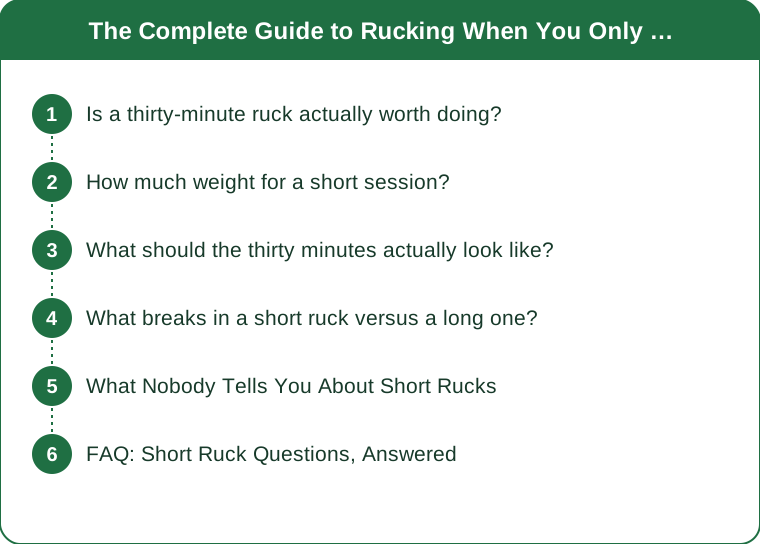
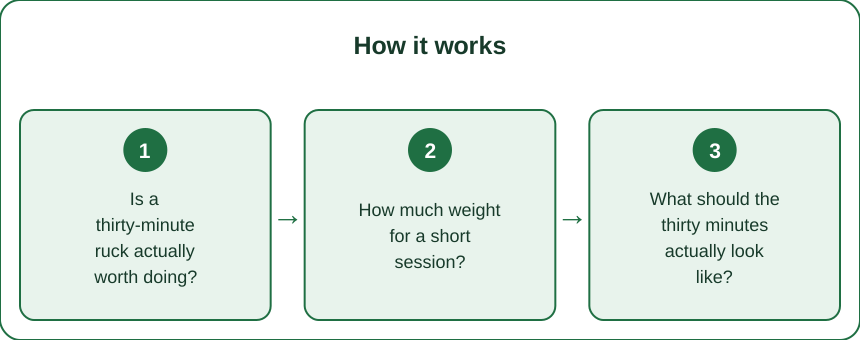
Is a thirty-minute ruck actually worth doing?
Yes, and for reasons that are specific rather than a consolation prize.
Loaded walking sits in a genuinely useful place. It raises cardiovascular demand considerably above unloaded walking while keeping impact far below running. Carrying a pack raises the metabolic cost of walking substantially compared with the same pace unloaded, which means thirty loaded minutes is not thirty ordinary minutes.
Postural and trunk demand is continuous. The load pulls you backward and slightly to whichever side is heavier, and resisting that for thirty straight minutes is real work for the muscles along your spine and around your hips. This is the part that transfers most obviously to carrying children, groceries, and luggage.
Bone loading is present. Weight-bearing exercise with additional external load is relevant to bone health, and rucking delivers it in a low-skill, low-impact package. That matters more with each decade.
What thirty minutes does not do: build the specific durability for long-distance loaded work. The failure points on a ten-mile ruck — feet, shoulders, hot spots, chafing — do not show up in thirty minutes, which is exactly why the short session feels easy and why it does not prepare you for the long one. If a long ruck is your goal, you still need occasional long rucks.
How much weight for a short session?
Slightly more than your long-ruck weight, and much less than the temptation suggests.
The reasoning is straightforward. On a long ruck the limiting factor is accumulated load — your form holds for the first hour and starts drifting after, so you pick a weight your posture can survive for the full duration. In thirty minutes you never reach that point, so a modestly heavier pack stays within good form.
The practical numbers: if your usual comfortable ruck weight is around 20 pounds for an hour-plus, something in the 25 to 30 pound range is reasonable for thirty minutes, once you have built up to it. A common starting point for beginners is roughly 10 percent of bodyweight, and building from there in increments of about 5 pounds every two to three weeks rather than in jumps.
The trap: reasoning that a short session justifies a dramatically heavier pack. It does not, for two reasons. Spinal and joint loading is per-step rather than per-session, so a much heavier pack raises the per-step cost immediately regardless of how long you go. And connective tissue adapts considerably more slowly than muscle and cardiovascular fitness do — your legs and lungs will accept a weight jump weeks before your tendons and feet will. Most rucking injuries come from exactly this gap.
One loading detail that matters more in a short session than a long one: pack the weight high and close to your back, sitting between your shoulder blades rather than sagging into the base of the pack. A low, loose load pulls you backward and forces a compensatory forward lean, which is where the lower back complaints originate.
What should the thirty minutes actually look like?
Structured, because there is not enough time for anything to happen by accident.
Option 1 — the steady pace push. Five minutes easy to warm up, twenty minutes at a pace where holding a conversation is difficult but possible, five minutes easy. This is the default and the one that builds the most aerobic fitness per minute.
Option 2 — the hill session. If you have any incline available, use it. Loaded uphill walking raises the demand sharply without raising speed, which keeps impact low. Four to six climbs with easy walking down. The downhill is where the load is hardest on your knees, so shorten your stride and slow down on the descent rather than letting gravity do it.
Option 3 — the pace ladder. Five minutes easy, then alternate three minutes brisk and two minutes easy. Useful for people who find steady work boring, which is a legitimate reason to structure a session differently.
What not to do: wander at a conversational stroll with a heavy pack for thirty minutes. That is a walk with extra spinal loading and very little cardiovascular return, which is the worst combination available. If the weight is on, the pace should be doing something.
On timing — this is a session that fits well before work, and in late August a 6:30am start is meaningfully cooler than a 6:30pm one. Heat raises the cardiovascular cost of the same session considerably, so if you are pushing pace, morning is the better slot while the weather is still warm.

What breaks in a short ruck versus a long one?
Different things, which is why short rucks feel deceptively easy.
Long-ruck failure points, none of which appear in thirty minutes:
- Foot hot spots and blisters, which need an hour-plus to develop
- Shoulder pressure numbness, from sustained strap load
- Chafing at the hip belt and under the arms
- Postural fatigue, where form drifts because the muscles holding it have given up
Short-ruck failure points, which are the ones to watch:
- Shin discomfort from pace, not from load. Walking fast in a loaded pack in unsupportive shoes puts real demand on the front of the lower leg
- Lower back tightness from a poorly packed load that pulls you backward for the whole session
- Knee load on descents, which is per-step and therefore fully present in a short session
- Weight-jump injuries, because the short duration makes a heavier pack feel manageable in the moment
The short session’s genuine advantage: you can do it more often. Three thirty-minute rucks a week is 90 minutes of loaded work at a frequency that builds tissue tolerance steadily. One ninety-minute ruck weekly delivers the same total in a single dose, which is harder on the tissue and easier to skip.
As general information rather than medical advice: sharp pain in the shins, knees, or lower back that persists past a session or two is a signal to reduce weight and get it assessed, not to push through. Loaded walking is forgiving until it is not.
What Nobody Tells You About Short Rucks
Your pack setup matters more, not less. Over thirty minutes you will not bother adjusting a badly packed load, so you carry the flaw for the entire session. Take the extra ninety seconds before you leave: weight high, snug against your back, hip belt taking real load, nothing shifting when you jump on the spot.
Shoes are the most common uncontrolled variable. A short fast ruck in worn-out running shoes is a different session from the same ruck in supportive trail shoes or boots. The load amplifies whatever your shoe is or is not doing.
The session ends before your body tells you the weight was wrong. This is the genuinely counterintuitive part. On a long ruck, an excessive load announces itself at mile four. On a short one, you finish feeling fine and find out tomorrow. Judge your weight by how you feel the next morning, not by how the session went.
Frequency compounds faster than you expect. Three short rucks a week for a month is twelve loaded sessions. That is enough to change how a pack feels, and most people arrive at their first long ruck of the season noticeably more prepared than they were the year before.
A short ruck is a legitimate way to reach a destination. Rucking to the store and carrying groceries back is a real session, and it removes the biggest obstacle to consistency, which is that it feels like an extra errand rather than a normal one.
FAQ: Short Ruck Questions, Answered
Can I ruck every day if the sessions are short?
Most people can handle four to five loaded sessions a week at a modest weight once they have built up over a couple of months, but starting there is a reliable way to develop a foot or shin problem. Three a week is a good target, with at least one non-consecutive day, and let how you feel the following morning govern whether you add a fourth.
Should I use a weighted vest instead of a pack?
A vest distributes load more evenly and eliminates most strap and chafing issues, which makes it good for short fast sessions. A pack builds the specific tolerance for carrying an actual pack, which is what you want if long rucks are the goal. For thirty-minute pace-focused sessions, a vest is often the more comfortable choice.
Is rucking better than running for thirty minutes?
Different, not better. Running produces a higher cardiovascular demand per minute with considerably more impact; rucking gives you loaded, low-impact work with a strong postural and trunk component. If your joints tolerate running and cardiovascular fitness is the goal, running is more efficient. If you want load-bearing work that your knees will still accept in ten years, rucking is the easier thing to sustain.
TL;DR:
- A thirty-minute ruck raises cardiovascular demand well above walking with far less impact than running
- Load slightly heavier than your long-ruck weight, but resist the big jump — tendons adapt slower than lungs
- Structure the time: steady push, hills, or a pace ladder. A loaded stroll is the worst use of a pack
- Judge the weight by how you feel the next morning, since the session ends before your form degrades
The short ruck is not the compromise version. It is the one you will actually do three times a week, and three times a week is what builds the tissue tolerance that makes the long ones possible.
Keep Reading
This article is for general informational and styling purposes only. Fit, sizing, and product availability may vary.