Why a Ruck Can Feel Completely Fine Until Mile 3 — Then Falls Apart Fast
Quick Answer: Early in a ruck, fresh muscles, an efficient gait, and a well-positioned load combine to make the effort feel manageable, but as stabilizing muscles fatigue and the load subtly shifts position with accumulated movement, the effort required to maintain the same pace increases sharply rather than gradually — which is why many ruckers experience a fairly sudden, rather than steadily building, decline around the same point in longer rucks.
The drop-off around mile 3 isn’t random — it’s usually the point where several small fatigue factors cross a threshold at roughly the same time.

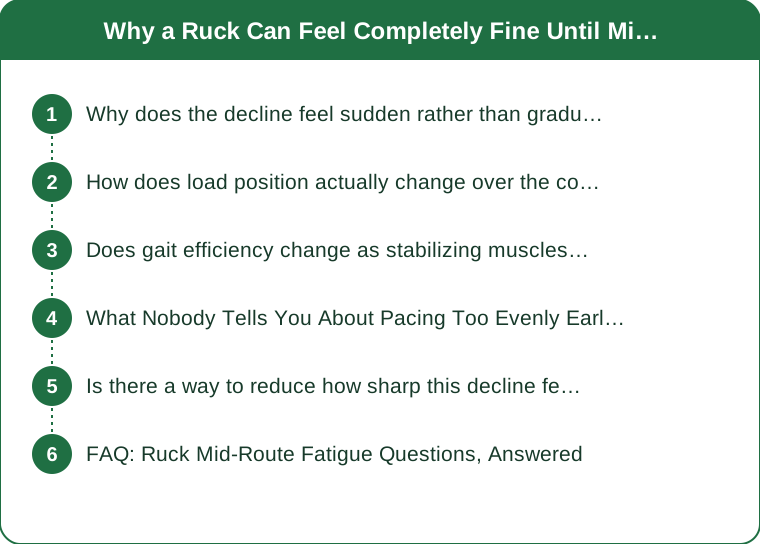
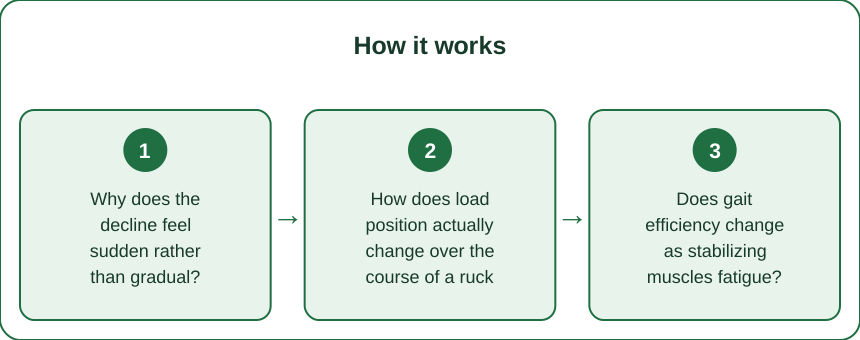
Why does the decline feel sudden rather than gradual?
Several fatigue-related factors — stabilizing muscle endurance, core fatigue, minor load-shifting, and gait efficiency — tend to degrade at different rates but often cross a noticeable threshold around a similar point in a ruck of a given weight and pace, meaning the individually gradual declines compound into what feels like a single, sudden turning point rather than each factor announcing itself separately.
How does load position actually change over the course of a ruck without repacking?
Even a well-packed ruck naturally settles and shifts slightly with the repetitive motion of walking, often drifting lower or to one side over time, which changes the effective leverage and center of gravity the body has to stabilize against — a small shift that was negligible in mile one becomes a meaningfully larger stabilization demand by mile three, adding fatigue that has nothing to do with cardiovascular conditioning.
Does gait efficiency change as stabilizing muscles fatigue?
Yes — as hip, core, and ankle stabilizers fatigue, stride mechanics subtly degrade (shorter, less efficient steps, more upper body compensation), which increases the energy cost of maintaining the same pace even though heart rate and breathing might not show dramatic change yet, creating a mismatch between how hard the effort feels and what cardiovascular metrics alone would suggest.

What Nobody Tells You About Pacing Too Evenly Early On
A common but counterintuitive mistake is pacing the first mile or two exactly the same as a planned steady pace for the whole route, which sounds correct but doesn’t account for the fact that stabilizing muscle fatigue accumulates faster than cardiovascular fatigue during a weighted ruck. Starting at a very slightly conservative pace for the first third of a route — even when it feels almost too easy — tends to preserve stabilizing muscle capacity better and delay the mile-three-style decline more effectively than an evenly split pace does.
Is there a way to reduce how sharp this decline feels?
Periodically checking and adjusting pack position during longer rucks before it drifts too far, deliberately engaging core and maintaining upright posture rather than letting early fatigue creep into slouching, and building rucking-specific stabilizer endurance separately (not just general cardio fitness) all reduce how sharply the decline hits at the point it typically occurs.
FAQ: Ruck Mid-Route Fatigue Questions, Answered
Does ruck weight change where in a route this decline typically shows up?
Yes — heavier loads tend to produce this decline earlier, since stabilizing demand scales with load, while lighter rucks can often be sustained longer before a similar threshold is reached.
Is stopping to briefly readjust the pack worth the time cost?
Usually yes — a 30-60 second pack adjustment that restores better load position often pays for itself in reduced fatigue and improved mechanics for the remainder of the route.
Does this pattern mean rucking fitness isn’t improving?
Not necessarily — the point where this decline occurs typically shifts later as rucking-specific stabilizer strength and endurance improve with consistent training, even if overall cardiovascular fitness was already solid beforehand.
TL;DR:
- The mid-route decline is usually several fatigue factors crossing a threshold around the same point
- Load naturally shifts during a ruck, adding a stabilization demand that grows over distance
- Gait efficiency degrades as stabilizers fatigue, increasing effort even before heart rate shows it
- A slightly conservative early pace tends to delay the sharp decline more than even pacing does
- Rucking-specific stabilizer training shifts this fatigue point later over time
The mile-three wall is a predictable convergence of small fatigue factors, not a random bad day.
Keep Reading
This article is for general informational and styling purposes only. Fit, sizing, and product availability may vary.