Why Ruck Weight Should Increase More Slowly Than It Often Feels Necessary To
Quick Answer: Cardiovascular and muscular systems generally adapt to added rucking weight faster than joints, tendons, and ligaments do, meaning a ruck weight increase can feel entirely manageable from a breathing and leg-effort standpoint while the slower-adapting connective tissue hasn’t caught up yet — this mismatch is why rucking-specific progression guidelines typically recommend smaller, more gradual weight increases than cardiovascular feeling alone would suggest is necessary.
Feeling ready for more ruck weight based on cardio and muscle fatigue alone is genuinely unreliable, since the connective tissue that bears much of rucking’s repetitive load adapts on a meaningfully slower timeline.

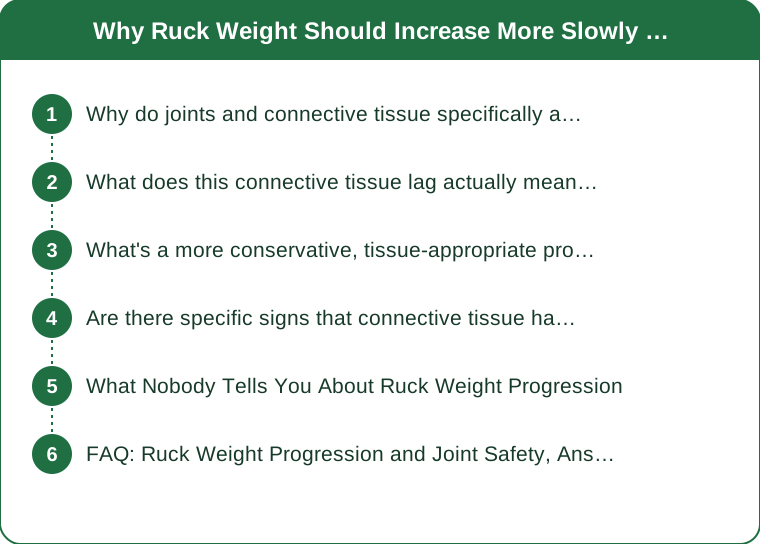
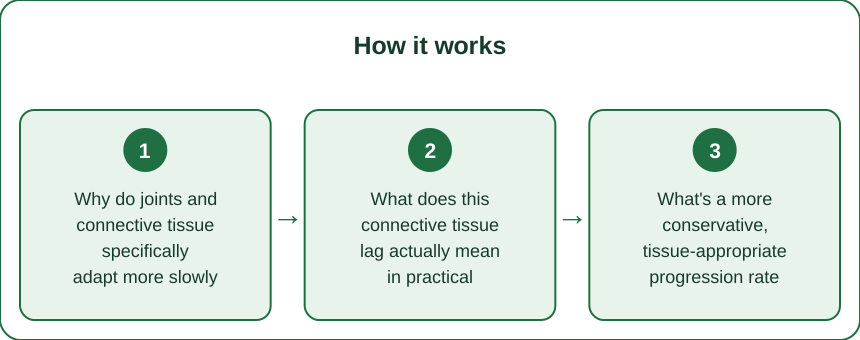
Why do joints and connective tissue specifically adapt more slowly to added rucking load than muscles and cardiovascular fitness do?
Muscular strength and cardiovascular capacity can improve relatively quickly with consistent training, often showing meaningful adaptation within a few weeks. Connective tissue like tendons and ligaments has a lower blood supply and slower cellular turnover rate, meaning it adapts to increased mechanical load over a considerably longer timeline, often described in months rather than weeks — a mismatch that becomes especially relevant under rucking’s sustained, repetitive loading pattern.
What does this connective tissue lag actually mean in practical terms for someone progressing their ruck weight?
It means feeling cardiovascularly and muscularly ready for a weight increase doesn’t necessarily mean the joints and connective tissue are equally ready, and progressing weight based purely on that cardio-muscular feeling risks outpacing the tissue’s actual adaptive capacity, increasing injury risk (particularly to knees, hips, and lower back) even while the workout itself still feels achievable in the moment.
What’s a more conservative, tissue-appropriate progression rate commonly recommended for rucking specifically?
Many rucking-specific guidelines suggest increasing pack weight by roughly 10% or less every few weeks, rather than jumping up whenever a session starts to feel easy, giving connective tissue meaningfully more time to adapt alongside the faster-adapting cardiovascular and muscular systems. This is considerably more conservative than progression rates common in some other training contexts, specifically because of rucking’s connective-tissue-heavy demand.

Are there specific signs that connective tissue hasn’t caught up, even if a session still feels achievable overall?
Persistent joint discomfort (rather than typical muscle fatigue), a nagging ache that continues into the next day rather than resolving, or discomfort specifically localized to a joint area rather than a muscle belly are signals worth paying attention to as potential signs the connective tissue adaptation hasn’t caught up to the current weight and volume, even if breathing and leg muscles feel fine during the ruck itself.
What Nobody Tells You About Ruck Weight Progression
Distance and duration matter just as much as absolute pack weight for connective tissue stress, and increasing both weight and distance simultaneously compounds load faster than either increase alone would, a combination worth avoiding — progressing one variable (weight or distance) at a time, rather than both together, gives connective tissue a clearer, more gradual adaptation stimulus and makes it easier to identify which variable might be causing any discomfort that does show up.
FAQ: Ruck Weight Progression and Joint Safety, Answered
How often should ruck weight realistically be increased, given this conservative connective tissue timeline?
Many experienced ruckers suggest waiting at least 2-3 weeks of consistent training at a given weight before considering a modest increase, rather than increasing every session or every week.
Does footwear or ruck fit meaningfully affect how much strain added weight places on the joints?
Yes, significantly — a properly fitted pack with weight positioned close to the back and supportive, appropriate footwear both meaningfully reduce unnecessary joint strain independent of the actual pack weight itself.
Is it reasonable to reduce ruck weight temporarily if joint discomfort appears, rather than pushing through?
Yes, this is a reasonable and often recommended response — temporarily reducing weight or volume to let connective tissue catch up, rather than pushing through persistent joint discomfort, is a more sustainable long-term approach.
TL;DR:
- Connective tissue adapts to added rucking load more slowly than muscles and cardiovascular fitness do
- Feeling cardio-ready for more weight doesn’t mean joints and tendons have equally caught up
- A conservative progression rate (roughly 10% every few weeks) better matches connective tissue’s actual timeline
- Persistent joint-localized discomfort, rather than typical muscle fatigue, signals tissue hasn’t adapted yet
Rucking progression pace should follow the slowest-adapting system, not the fastest — pacing weight increases around connective tissue’s genuinely longer timeline meaningfully reduces injury risk over the long run.
Keep Reading
This article is for general informational and styling purposes only. Fit, sizing, and product availability may vary.