Why You Should Add Distance Before Weight and When to Break That Rule
Quick Answer: Progress rucking by extending distance at a fixed weight until the distance is comfortable, then raise weight in small jumps and shorten the distance again. The reason is adaptation speed: your cardiovascular system improves in weeks, but the tissues that actually fail under a pack — feet, achilles, hip stabilizers, the skin under your straps — adapt over months. Distance-first respects the slow systems. Weight-first flatters the fast one and injures the slow ones.
The rule has real exceptions, and they are narrower than the internet suggests.

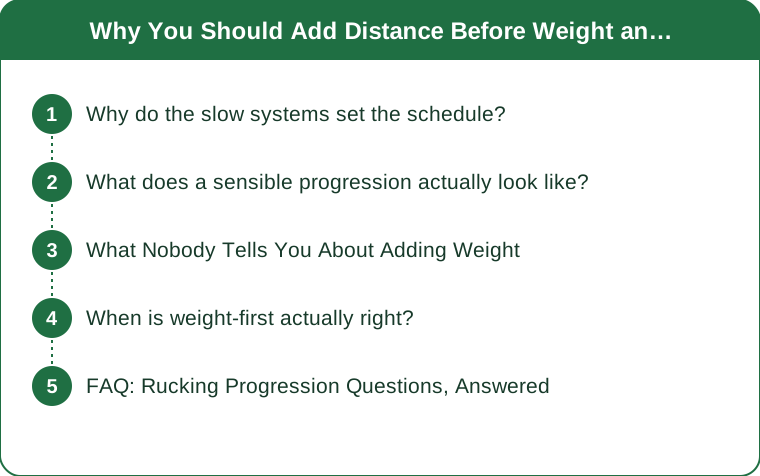
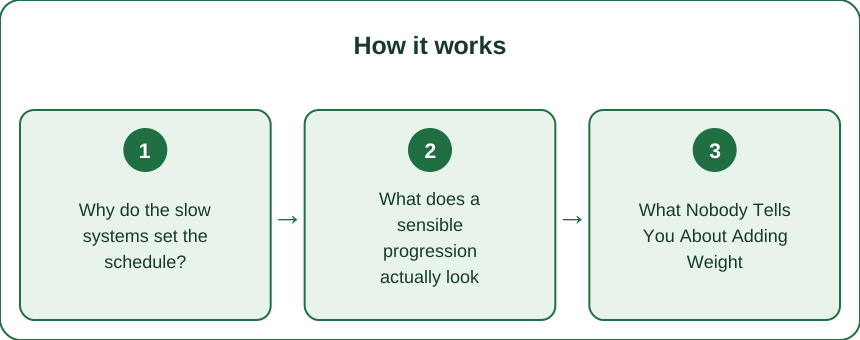
Why do the slow systems set the schedule?
Because a chain rated by its weakest link does not care how strong the strongest link is.
Rucking feels like cardio, so people progress it like cardio — and aerobically, that works. Heart and lungs respond to a new training stimulus within a few weeks. Six weeks in, the same ruck that once left you breathing hard feels almost casual, and the obvious conclusion is that you are ready for more weight.
The systems that are not ready do not send progress reports. Bone remodels on a timescale of months. Tendon — the achilles, the plantar tissue, the tibialis — stiffens and strengthens far slower than muscle. The small stabilizers around the hips that keep your pelvis level under load build capacity gradually and quietly. None of these give you day-to-day feedback the way lungs do. They give you one piece of feedback, late: pain.
This mismatch explains the classic rucking injury timeline. Weeks one through four feel great. The weight goes up because the breathing got easy. Weeks six through ten produce the shin splint, the achilles ache, the hip that complains on stairs. The cardio system wrote a check the connective tissue could not cash.
Distance-first works because added minutes at a known weight are a gentler, more even stimulus to the slow systems than added pounds. Every step at a familiar load is a rep the tissue has already practiced; a heavier pack changes the force on every structure at once — feet, joints, strap contact points, lower back lever arms — with no rehearsal.
A pack is also not a barbell: you cannot rack it mid-ruck when form degrades. Whatever load you chose at the trailhead, you are carrying home.
What does a sensible progression actually look like?
Simple rules, boring on paper, effective for years.
Start lighter than your ego wants. Ten to fifteen pounds for most women starting out — roughly a loaded school backpack. If you already train, this will feel almost insulting for the first two weeks. That is the correct feeling. You are training your feet and your strap tolerance, not your pride.
Extend time at that weight until an hour is genuinely comfortable. Add ten to fifteen minutes to your long ruck each week, walking at a pace where conversation is possible. Comfortable means: no hot spots, no next-day foot or shin soreness, shoulders fine at the end.
Then raise weight by five pounds and cut the distance back by a third. Rebuild the distance at the new weight over the following weeks. This sawtooth — up in weight, back in distance, rebuild — is the whole method. Most people do well raising weight roughly once every three to five weeks, not weekly.
Hold one variable still, always. Never raise weight and distance in the same week. When in doubt, repeat a week; a repeated week costs nothing and an inflamed achilles costs two months.
A useful ceiling for fitness rucking is about one-quarter to one-third of body weight. Beyond that, the injury math worsens fast and the extra training benefit is thin unless you are preparing for a specific event that demands it.
What you wear underneath matters more as weight climbs: a hip belt rides directly on your waistband, so high-waisted leggings with a flat, wide band beat anything with a knotted drawstring or thick seam at the hips — the same logic that makes buttery-soft leggings the default under any harness or belt. Seams under load become abrasion lines around mile three.

What Nobody Tells You About Adding Weight
The first casualty of too much weight is your walking form, not your safety. Overloaded ruckers shorten their stride, lean forward from the waist, and start hitting the ground harder on one side. The ruck still gets completed — it just quietly becomes a repetitive-strain generator. If a friend says you look different at the end than the start, the pack is ahead of your capacity.
Weight placement changes effective difficulty as much as weight amount. The same twenty pounds carried high and tight against your back feels several pounds lighter than the same plate sagging at the bottom of the bag. Before you conclude you are ready for more, repack what you have: heavy items high, close to the spine, cinched so nothing shifts.
Your skin has a training age too. Strap contact points — collarbones, the front of the shoulders, the iliac crest under a hip belt — toughen with exposure like feet do. A weight jump your muscles handle easily can still rub these points raw, which is why new weight should debut on a short ruck, never the long one.
Hills multiply weight without touching the scale. Adding a hilly route at your current load is a genuine progression, often smarter than adding pounds on flat ground. Descents especially: braking a loaded body downhill is the hardest thing your knees do all week.
The scale of soreness moves down your body over time. Early weeks, shoulders complain. Months in, it is feet and calves. That migration is normal; soreness that localizes to one shin, one heel cord, or one hip and returns every ruck is not soreness — it is a schedule warning.
When is weight-first actually right?
A few legitimate cases — with guardrails.
A tested event with a fixed load. If you are preparing for a challenge that specifies thirty pounds, you eventually must train at thirty pounds; no volume of light rucking fully substitutes. The guardrail: build to event weight over multiple months, arriving at the full load with several weeks of short rucks under it before the distance builds.
Serious time constraints. If your window is forty-five minutes and it cannot grow, weight becomes your main progression lever by default. The guardrail: smaller jumps — two or three pounds, not five — because you have surrendered the gentler variable.
Strength-biased goals. If you ruck primarily as loaded strength work rather than cardio, heavier and shorter is coherent. The guardrail: treat it like lifting, with rest days between sessions and a hard stop when posture degrades, and accept that this is a different activity from endurance rucking.
Plateau at genuinely light loads. Once fifteen pounds for ninety minutes is easy in every tissue — no hot spots, no next-day anything — sitting there for months out of caution is its own mistake. Progress is the point; the rule only sequences it.
Who should not break the rule: anyone in their first three months, anyone returning from a lower-limb injury, and anyone whose feet still blister on long rucks — skin that cannot handle current friction has cast a veto.
This is general information, not medical advice. Pain that is sharp, localized to bone, or that worsens as a ruck goes on — rather than warming up and easing — is a reason to stop and get assessed, not to reduce weight and push through.
FAQ: Rucking Progression Questions, Answered
How fast can I add distance at a fixed weight?
Around ten to fifteen minutes per week on your longest ruck is a durable rate for most people. If a week leaves your feet or shins sore into the second day, repeat it before extending again.
Is it better to ruck more often or longer?
For the slow tissues, frequency at moderate length beats one heroic weekly effort. Two or three rucks a week, one longer and the rest shorter, builds capacity faster and safer than a single long Saturday march.
What should I use for weight?
Purpose-made ruck plates ride flattest, but wrapped dumbbells, sand, or water containers work at light loads. Whatever you use, immobilize it — a shifting load changes your gait every step and is worse than a slightly heavier fixed one.
Can I count my rucks as strength training?
Partially, at meaningful loads — but rucking will not maintain leg or hip strength by itself. Two short strength sessions a week — squats, step-ups, calf raises — protect the exact tissues rucking stresses, and make the distance-first progression run smoother.
TL;DR:
- Your heart adapts in weeks; feet, tendons, and hip stabilizers take months — and they only report problems after the fact.
- Progress by extending distance at a fixed weight, then raise weight five pounds and cut distance back: a sawtooth, one variable at a time.
- Repack before you progress: weight high and tight rides lighter, and hills are a progression that never touches the scale.
- Weight-first is legitimate for fixed-load events, hard time caps, and strength goals — with smaller jumps and shorter rucks.
Decide your next four weeks now, at your desk, and write the plan down. The trailhead version of you, breathing easily, is not a reliable narrator about what your tendons are ready for.
See It in Motion
Seen here: Super High Waist Embossed Yoga Leggings with Inner Pocket — shop it on bubblelime.com
Keep Reading
This article is for general informational and styling purposes only. Fit, sizing, and product availability may vary.