Why Your Ruck Feels Heavier on Certain Days (Same Weight, Same Route)
Quick Answer: A ruck feels heavier on the same weight because of sleep, recent training load, pack fit drift, and even weather — not because the pack magically changed. Fatigue and dehydration lower your tolerance for the exact same load.
You weighed the plates. Same 30 pounds as last week. Same trail, same boots. And yet today’s ruck felt like carrying twice the weight from the first half-mile. Nothing about the pack changed — what changed is the body carrying it.

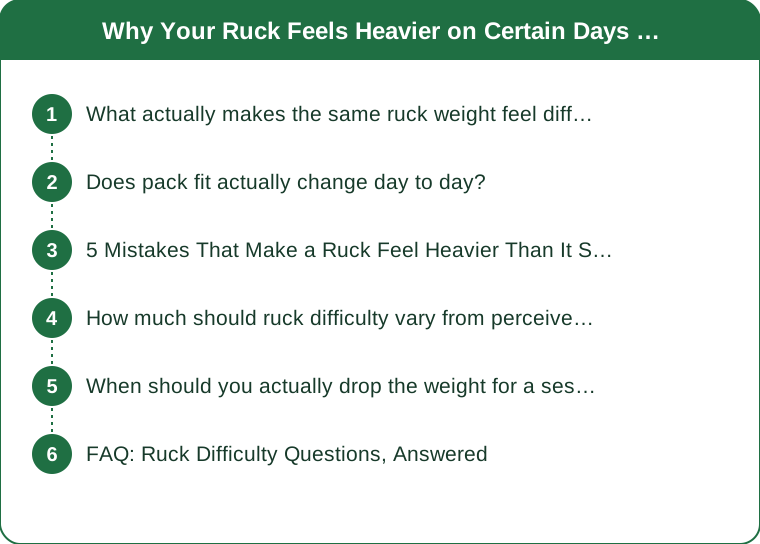
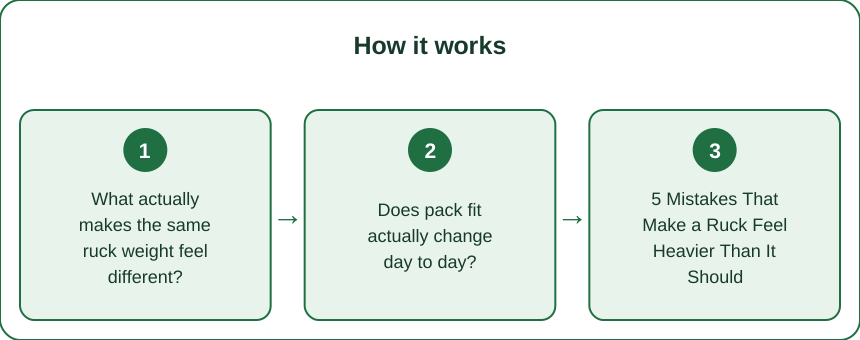
What actually makes the same ruck weight feel different?
Several factors shift session to session and stack on top of each other:
- Sleep debt lowers perceived exertion tolerance measurably — a bad night can make identical loads feel 10-20% heavier by feel
- Residual fatigue from a hard training day 24-48 hours earlier means your stabilizing muscles are already partially spent before you even strap in
- Hydration status affects both muscular endurance and how your core braces under load
- Heat and humidity force your body to spend energy on cooling that would otherwise go toward carrying the pack, which reads as the ruck feeling heavier even at identical weight
Stack two or three of these on a bad day and a familiar ruck can feel like a completely different exercise.
Does pack fit actually change day to day?
Yes, more than most people realize. How you load your pack — even shifting straps a half-inch, or how tightly you cinch the hip belt — meaningfully changes where the weight sits. A pack riding slightly low pulls on your shoulders and lower back far more than the same weight riding high and tight against your upper back.
Small day-to-day differences in how rushed you were putting it on (strap tension, whether the load is centered) can account for a noticeably different-feeling carry, even with the same plates inside.
5 Mistakes That Make a Ruck Feel Heavier Than It Should
1. Loading the weight low in the pack. This shifts your center of gravity backward and strains your lower back — pack the heaviest items high and close to your spine.
2. Loose hip belt. Your hips should carry 60-70% of the load; a loose belt shifts nearly all of it onto your shoulders.
3. Rucking in worn-out shoes. Compressed cushioning changes how impact travels up your legs, making the same distance feel harder on tired joints.
4. Skipping a warm-up. Cold hip flexors and a cold upper back take the first 10-15 minutes to ‘wake up’ — rushing into pace with a cold body makes early minutes feel disproportionately hard.
5. Ignoring the heat index, not just temperature. 75°F with high humidity can feel harder on the body than 85°F dry — humidity blunts your body’s ability to cool itself through sweat evaporation.

How much should ruck difficulty vary from perceived effort alone?
Some day-to-day variance is completely normal — expect roughly a one or two point swing on a 1-10 effort scale for the same load and route based on sleep and recovery alone. What’s not normal is a load that used to feel manageable becoming consistently, progressively harder across multiple sessions in a row without any weight increase — that pattern suggests you need more recovery between sessions, not more grit.
When should you actually drop the weight for a session?
If your form is breaking down — rounded shoulders, excessive forward lean, or your pace collapsing well below normal — that’s the signal to drop weight or distance for that specific session rather than pushing through. A hard day rucked at reduced load beats a hard day rucked at full load with breakdown form, since form breakdown under load is where rucking injuries actually happen, not from the weight itself.
FAQ: Ruck Difficulty Questions, Answered
Should I ruck the same weight every session regardless of how I feel?
No — treat your planned weight as a target, not a mandate. A 10-20% reduction on a rough day keeps the training habit intact without forcing bad form under full load.
Does the time of day I ruck matter?
Yes, heat and humidity peak differently through the day — early morning or evening rucks in summer months are measurably easier on your body than midday sessions at the same weight.
How do I know if it’s normal variance versus overtraining?
Normal variance is occasional and resolves within a session or two. Overtraining shows up as a consistent multi-week trend of the same load feeling progressively worse — that’s a signal to add a rest week, not push harder.
TL;DR:
- Ruck weight feeling different day to day is mostly sleep, fatigue, hydration, and heat — not the pack
- Pack fit (hip belt tightness, load height) changes carry difficulty as much as actual weight does
- A 1-2 point swing in perceived effort is normal; a progressive multi-week worsening trend is not
- Drop weight on days form starts breaking down — that’s where injuries happen, not from the number on the plates
Same ruck, different day, different body — adjust the session, not your sense that something’s wrong.
Keep Reading
This article is for general informational and styling purposes only. Fit, sizing, and product availability may vary.