Why Your Ruck Weight Should Increase in Smaller Steps Than It Feels Like It Should
Quick Answer: Ruck weight is generally recommended to increase in small increments of about 5-10% of current load every one to two weeks, rather than large jumps, because cardiovascular fitness and muscular strength typically adapt faster than the connective tissue (tendons, ligaments) and joints that bear the compounding load of a weighted pack — feeling ready cardio-wise doesn’t mean the joints have caught up yet.
The 20-pound ruck stopped feeling hard weeks ago. Heart rate barely climbs, legs feel strong, and 35 pounds seems like a reasonable next step — until the knees and lower back start complaining a few sessions in, well after the cardiovascular system already gave the green light.

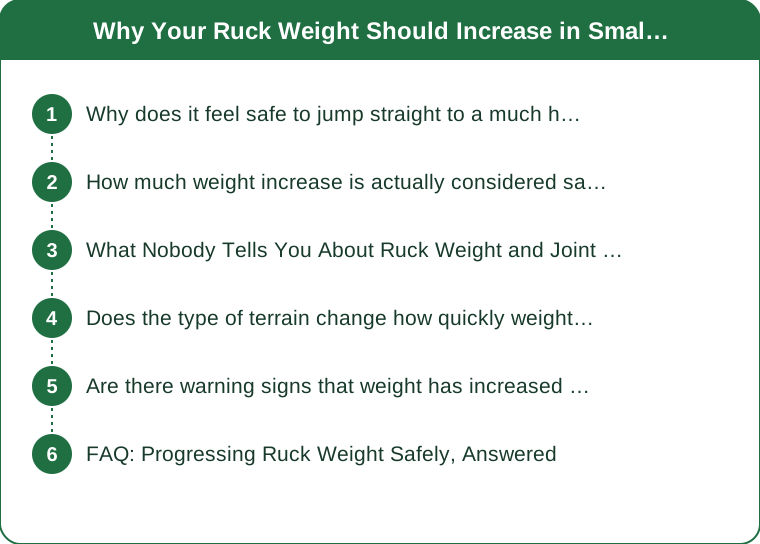
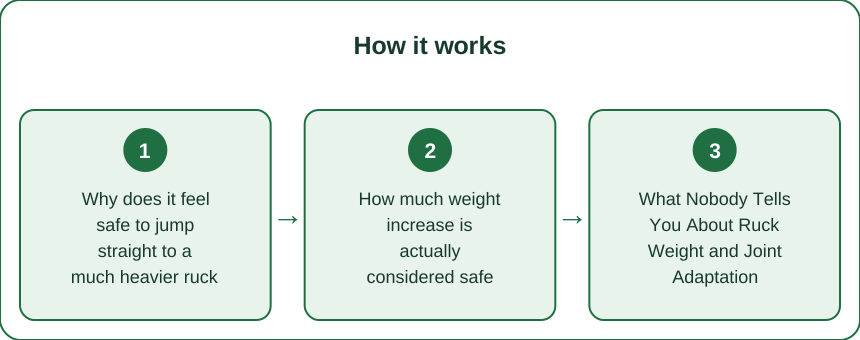
Why does it feel safe to jump straight to a much heavier ruck weight when the current one feels easy?
Cardiovascular and muscular strength adaptations tend to happen relatively quickly — often within a few weeks of consistent training — and these systems are what most directly drive the subjective sense of a given ruck weight feeling ‘easy,’ but connective tissue like tendons and ligaments, along with joint cartilage, adapts much more slowly to increased load, meaning the feeling of readiness from the cardiovascular and muscular side can significantly outpace how ready the joints and connective tissue actually are.
How much weight increase is actually considered safe at one time?
A common guideline is increasing total ruck weight by roughly 5-10% at a time, no more than about every one to two weeks, which allows connective tissue and joints time to adapt to the new compounding load gradually rather than being suddenly exposed to a meaningfully higher force with every step — a jump from 20 to 35 pounds represents a 75% increase, far beyond what connective tissue can safely adapt to in one step even if the muscles and cardiovascular system feel ready.
What Nobody Tells You About Ruck Weight and Joint Adaptation
Most rucking progression advice focuses on distance and pace milestones, but nobody tells you that the weight itself needs its own separate, slower progression timeline distinct from distance or pace — someone who’s built up to comfortably rucking six miles at 20 pounds hasn’t necessarily built the connective tissue resilience to handle 35 pounds over that same distance, even though both numbers might feel achievable on paper.

Does the type of terrain change how quickly weight can be safely progressed?
Yes — rucking on uneven or hilly terrain places more variable and often higher peak loads on joints than flat, even ground, meaning weight progression should generally be more conservative when regularly rucking on trails or hills compared to consistently flat routes, since the terrain itself is already adding load variability on top of whatever pack weight is being carried.
Are there warning signs that weight has increased faster than joints can handle?
Persistent joint discomfort (rather than general muscular fatigue) in the knees, hips, or lower back that continues into the following day or worsens over consecutive sessions is a signal that the current weight increase outpaced what the joints have adapted to, and scaling back to the previous comfortable weight for a few more weeks before trying the increase again is a reasonable response rather than pushing through.
FAQ: Progressing Ruck Weight Safely, Answered
How often is it reasonable to increase ruck weight?
Roughly every one to two weeks, in 5-10% increments, gives connective tissue and joints a reasonable adaptation window between increases, rather than increasing every single session.
Is it necessary to slow weight progression even if there’s no pain at all?
A cautious, gradual approach is still worth following even without current pain, since connective tissue adaptation happens gradually and without obvious symptoms until it’s overloaded, meaning absence of pain isn’t a reliable signal that a bigger jump is automatically safe.
Should someone with prior joint issues progress ruck weight even more conservatively?
Yes — anyone with a history of knee, hip, or back issues should consider even smaller weight increments and longer adaptation windows between increases, and checking with a doctor or physical therapist before starting a rucking weight progression plan is a reasonable step.
TL;DR:
- Cardiovascular and muscular fitness adapt faster than joints and connective tissue to increased ruck weight
- A 5-10% weight increase every one to two weeks is a safer progression than large jumps
- Hilly or uneven terrain adds load variability, warranting more conservative weight progression
- Persistent joint discomfort (not just muscular fatigue) is a signal to scale back and reprogress more slowly
This is general information, not medical advice — persistent joint pain should be evaluated by a professional. Feeling ready for more weight and actually being ready are answered by two different systems in the body, and the slower one — the joints — is the one that decides whether the jump was safe.
Keep Reading
This article is for general informational and styling purposes only. Fit, sizing, and product availability may vary.