Why Your Shoulders Hurt More Than Your Legs When Rucking
Quick Answer: Shoulder pain during rucking almost always means the pack’s weight is sitting too low and too far from your back, forcing your shoulders to carry load that should be transferring through your hips — tightening the top straps and using a hip belt fixes most cases.
You expected rucking to hit your legs and lungs, and instead you’re three days into a nagging shoulder ache that makes every strap adjustment feel worse, not better. This is one of the most common beginner rucking complaints, and it’s almost always a load-position problem rather than a sign you’re not built for it.

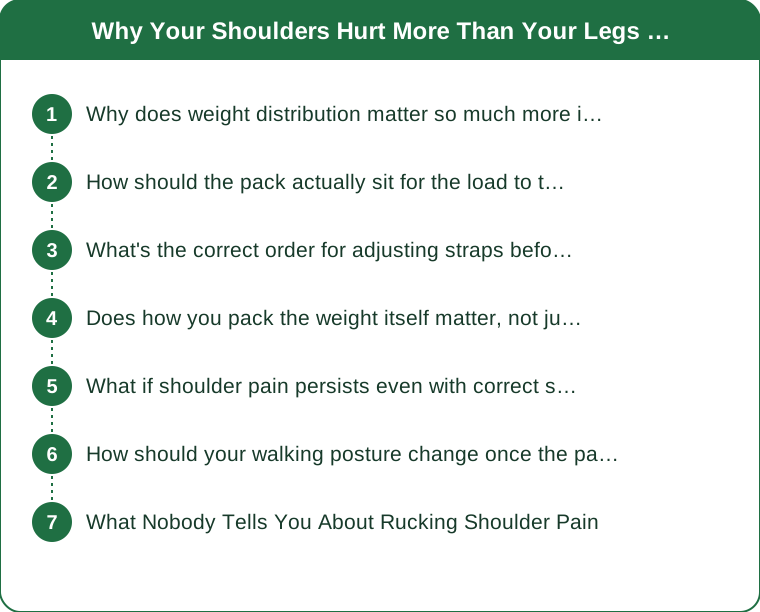
Why does weight distribution matter so much more in rucking than in normal backpacking?
Rucking typically uses heavier loads relative to distance and pace than casual hiking or commuting with a backpack, which means any distribution mistake gets amplified much faster. A poorly positioned 30-pound ruck at a brisk pace stresses your shoulders in a way a poorly positioned 15-pound daypack on a slow walk never would.
The core physics issue is that weight sitting low and away from your spine creates a longer lever arm, which multiplies the effective strain on your shoulders and upper back with every step.
How should the pack actually sit for the load to transfer to your hips?
The weight should sit high and close to your back, roughly between your shoulder blades and the top of your hips, not sagging down toward your lower back or hips. Tightening the top (load-lifter) straps pulls the pack’s center of mass closer to your spine, which is the single biggest lever for reducing shoulder strain.
If your ruck has a hip belt, cinching it snugly transfers a meaningful portion of the total weight off your shoulders directly onto your hips, which are far better equipped to carry sustained load.
What’s the correct order for adjusting straps before a ruck?
Start with the hip belt (if your pack has one) snugged onto the top of your hip bones first, then tighten the shoulder straps just enough to keep the pack close to your back without cutting into your shoulders, and finally adjust the load-lifter straps at a roughly 45-degree angle to pull the top of the pack toward your upper back. Skipping the hip belt step is the most common reason shoulders end up doing all the work.
Doing this adjustment sequence every single time, even for a pack you’ve used before, matters because how a pack settles changes slightly based on how you packed it that day.

Does how you pack the weight itself matter, not just the straps?
Yes — dense, heavy items should sit high and close to your back (near your shoulder blades), while lighter or bulkier items go toward the bottom or front of the pack. Packing your heaviest weight (like a ruck plate) at the bottom of the bag is a common mistake that creates exactly the low, swinging load that strains shoulders.
Most dedicated ruck plates or plate carriers are actually designed to sit against your back specifically for this reason, rather than loose in the bottom of a generic backpack.
What if shoulder pain persists even with correct strap adjustment?
Persistent pain despite correct setup can indicate the total weight is too heavy for your current conditioning — a common beginner mistake is jumping straight to 20-30% of bodyweight when 10% is a more sustainable starting point. Building up gradually over several weeks lets your shoulders, traps, and upper back adapt to carrying load before adding more.
Sharp, specific pain (rather than general fatigue) is also worth pausing rucking for entirely and evaluating with a physical therapist, since it may indicate a strap or posture issue beyond normal adjustment.
How should your walking posture change once the pack is set up correctly?
Keep a slight forward lean from your ankles, not your waist, and avoid hunching your shoulders forward to compensate for the weight, which actually increases strain rather than reducing it. Standing tall with shoulders back, even under load, keeps the weight transferring through your hips and core the way a properly fitted ruck is designed to work.
Many beginners unconsciously round their shoulders forward under load, which undoes even a well-adjusted strap setup — periodically checking your posture during a ruck helps catch this before it becomes painful.
What Nobody Tells You About Rucking Shoulder Pain
Most rucking guides focus heavily on pace, distance, and weight progression, but strap adjustment and load placement get far less attention despite being the actual root cause of most early shoulder complaints. A ruck that’s improperly adjusted will cause shoulder pain even at a very light weight, while a properly adjusted one at a heavier weight often feels more comfortable.
This is why two people carrying the identical pack and weight can have completely different experiences — the difference is almost always in how the straps were set and how the weight was packed, not individual toughness or fitness level.
TL;DR:
- Shoulder pain in rucking usually means the load sits too low and too far from your spine
- Tighten the hip belt first, then shoulder straps, then load-lifter straps at roughly 45 degrees
- Pack heavy items high and close to your back, not loose at the bottom of the bag
- If pain persists after correct setup, the total weight may be too heavy for your current level
Your shoulders aren’t failing you — your straps probably are, and a five-minute adjustment before your next ruck is usually all it takes to fix it.
Keep Reading
This article is for general informational and styling purposes only. Fit, sizing, and product availability may vary.